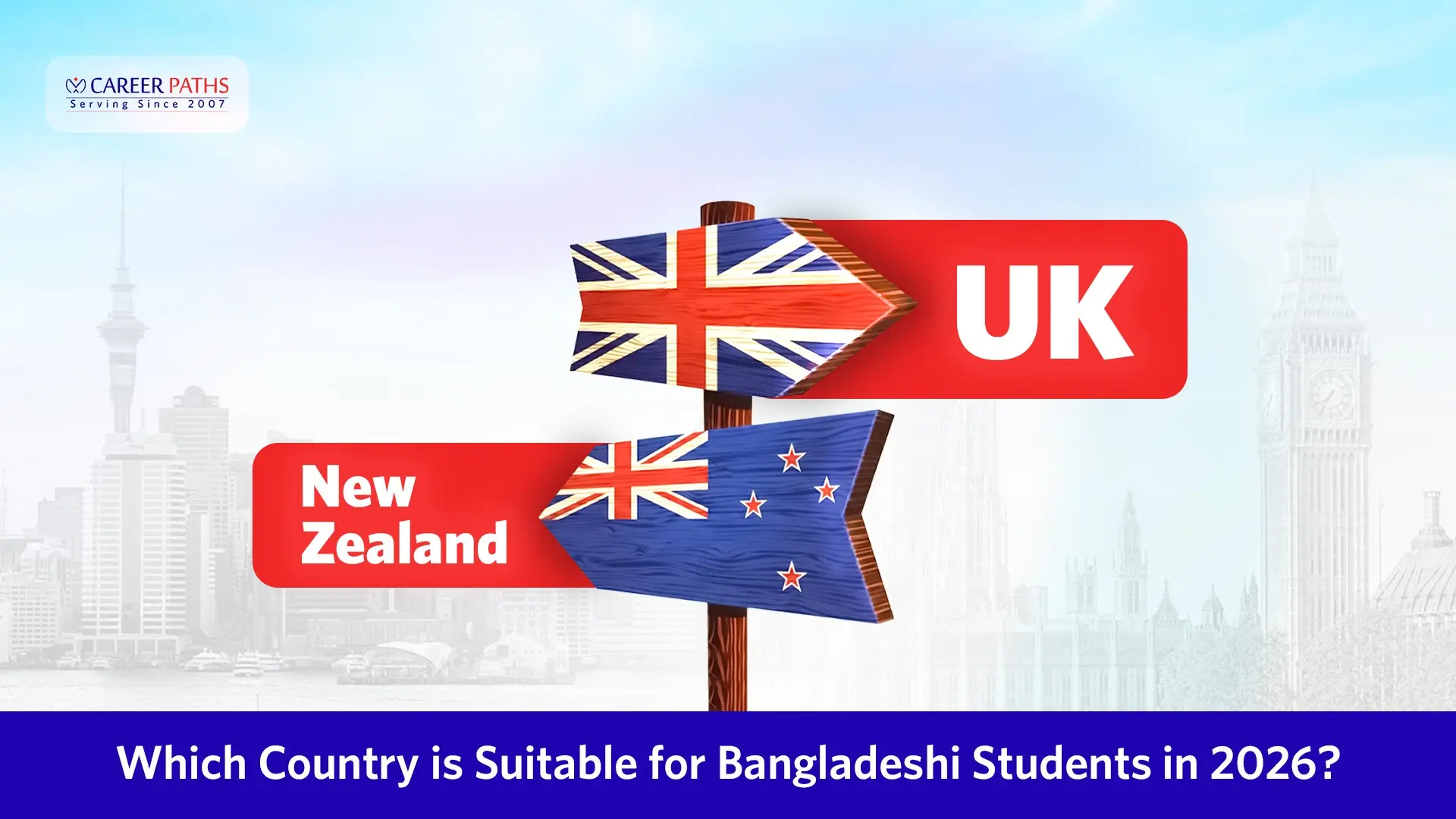
For Bangladeshi students planning to study abroad in 2026, choosing between the UK and New Zealand comes down to two distinct priorities: fast-track graduation versus long-term residency pathways. The UK remains an established study destination, offering globally recognised degrees, shorter programme durations (3-year Bachelor’s and 1-year Master’s), and streamlined career advancement through its Graduate Route visa. Meanwhile, New Zealand stands out as an increasingly popular alternative, providing internationally recognised degrees where all eight public universities rank in the QS World Top 500, set within one of the safest, most peaceful, and practical learning environments globally. Both nations present distinct academic and career advantages and post-graduation opportunities tailored to different student goals.
Which destination offers the best study, career, and settlement opportunities for Bangladeshi students in 2026 – the UK or New Zealand? Read through this complete comparative blog to discover which country aligns best with your academic goals, financial budget, and visa expectations.
Key Point Comparison: UK vs. New Zealand
Feature | United Kingdom (UK) | New Zealand |
Course Duration | • Bachelor’s: 3 Years (4 in Scotland)
• Master’s: 1 Year | • Bachelor’s: 3 to 4 Years
• Master’s: 1.5 to 2 Years |
Tuition Fees (Annual)
(Approx. conversion) | • Undergraduate: £14,500 – £22,700 (~BDT 24.0 Lakh – 37.6 Lakh)
• Postgraduate: £15,000 – £22,700 (~BDT 24.9 Lakh – 37.6 Lakh) | • Undergraduate: New Zealand $22,000 – $35,000 (~BDT 15.9 Lakh – 25.4 Lakh)
• Postgraduate: New Zealand $26,000 – $40,000 (~BDT 18.8 Lakh – 29.0 Lakh) |
Work Rights (During Study) | Up to 20 hours/week during term time; full-time during official university holidays. | Up to 25 hours/week applies to eligible full-time tertiary students (e.g., Bachelor’s/Master’s), whereas secondary or lower-level courses may still be capped at 20 hours. |
Post-Study Work Rights | Graduate Route Visa:
• 2 Years for Bachelor’s & Master’s graduates
• 3 Years for PhD graduates | Post Study Work Visa (PSWV):
• 1 to 3 Years depending on qualification level and location |
PR Opportunities | High Competition: Requires switching from a Graduate Route visa to a Skilled Worker visa. Graduates can qualify under the New Entrant rate (minimum £33,400/year or 70% of the job’s going rate). | Structured Pathways: Points-based Skilled Migrant Category (SMC) awards residence based on New Zealand qualifications, skilled job offers, and occupation shortages. |
Major Intakes | • September / October (Primary)
• January / February (Secondary) | • February / March (Primary)
• July (Secondary) |
Visa Rejection Percentage & Statistics
When evaluating international higher education options, visa approval statistics and scrutiny levels are often the decisive factor for Bangladeshi applicants. While university admissions focus on academic transcripts, visa outcomes are strictly governed by state immigration policies, fund verification protocols, and genuine student assessments.
Official Student Visa Dynamics | |
Average Grant Rate (BD Applicants): ~88% – 93% | Overall BD Approval (All Tiers Combined, including Private Colleges): Public Universities hold an 88%–90%+ approval rate. |
Primary Financial Hold Period: 28 Consecutive Days | University-Level (Level 7+) Approval Rate: ~88% – 90% |
Pre-Screening Responsibility: Shifted heavily to Universities (CAS Issuance) | Primary Financial Hold Period: 5 to 6 Months Minimum |
New Zealand: High Scrutiny, Strict Financial Verification
Official decision data published by Immigration New Zealand (INZ) demonstrates that offshore student visa applications originating from South Asia and Bangladesh in particular undergo rigorous scrutiny.
According to INZ offshore processing statistics, Bangladesh remains categorised among high-decline origin countries, with an overall 54% visa rejection rate (and a ~45% approval rate) across all institution tiers combined. However, this aggregate figure varies dramatically depending on the qualification level and institution type.
Approval Breakdown by Institution Tier in New Zealand
- Public Universities (Level 7 Bachelor’s / Level 8 Postgraduate / Level 9 Master’s): 88% – 90%+ Success Rate. INZ treats university-bound candidates as low-risk due to strict academic entry filters.
- Polytechnics & Institutes of Technology (Te Pūkenga): ~67% Success Rate.
- Private Training Establishments (PTEs) & Diploma Programs: ~45% – 50% Rejection Rate. High decline rates are concentrated in sub-degree or non-university applications.
Detailed Drivers for New Zealand Visa Refusals
Source of Funds & Financial “Seasoning” (The 6-Month Rule)
- Mandatory History: New Zealand requires liquid tuition and living funds (typically BDT 60 to 70 Lakh for single applicants, BDT 80 to 90 Lakh with dependents) to sit in an acceptable financial institution for at least 5 to 6 months prior to application submission.
- Unexplained Bulk Deposits: Any sudden lump-sum deposit added to a bank account shortly before applying (“cash seasoning”) is flagged automatically. Unless supported by verifiable legal sales deeds, tax returns, or audited business profits, it results in refusal under financial genuineness clauses.
- Sponsor Documentation: Sponsors (usually limited to immediate family: parents or spouse) must provide official tax returns (e.g., IT-10B forms in Bangladesh), trade licenses, or salary statements.
The “Bona Fide Applicant” Test (Section E5.10 of New Zealand Policy)
- Immigration officers must be convinced that the applicant intends a temporary stay for education and has compelling ties returning them to Bangladesh.
- Study Gaps: Unexplained gaps exceeding 1 to 2 years between previous graduation and the target program raise “Bona Fide” concerns.
- Academic Relevance: Changing academic streams (e.g., switching from a Bachelor of Arts to a Postgraduate IT Certificate) without documented work experience or foundational studies leads to immediate rejection under Genuine Student assessment.
Stringent Third-Party Verification
- INZ routinely conducts direct verification calls with Bangladeshi commercial banks, educational institutions, and employers. Incomplete documentation or mismatched bank balances trigger immediate refusals.
United Kingdom: High Approval Consistency and Standardised Assessment
Data compiled by the UK Home Office Visas and Immigration Statistics and Universities UK International (UUKi) confirms that the UK offers a more structured and predictable visa path for Bangladeshi applicants, with average national approval rates holding steady at 88% to 93% for genuine candidates.
Why the UK Visa Approval Process is More Predictable
The 28-Day Financial Rule
- Unlike New Zealand’s 6-month requirement, UKVI mandates that the total required funds (1 year’s remaining tuition fees + living costs must remain in the account for 28 consecutive days.
- The closing balance date must be within 31 days of the visa application date.
Shift of Academic Vetting to Universities
- A Confirmation of Acceptance for Studies (CAS) represents an official guarantee from a licensed UK higher education institution that the student has met all academic, English language (IELTS/PTE or university internal tests), and credibility criteria.
- Because universities conduct thorough pre-CAS interviews and document verification internally, UKVI visa clearance focuses primarily on verifying funds and clean legal or immigration history.
Clear Credibility Interview Parameters
When selected for a UKVI credibility interview, questions follow a standard structure: • Why did you choose this university and course over options in Bangladesh? • What specific modules will you study, and how do they connect to your long-term career goals? • Where is the campus located, and what will your accommodation arrangements cost?
Well-prepared applicants who demonstrate basic familiarity with their course outline routinely pass these interviews.
Detailed Financial & Compliance Comparison: UK vs. New Zealand
Criteria | United Kingdom (UKVI Rules) | New Zealand (INZ Rules) |
Minimum Financial Seasoning | 28 Days: Funds must be held continuously for at least 28 consecutive days. | 5 to 6 Months: Funds must demonstrate a clear 5- to 6-month historical trail. |
Acceptable Financial Sponsors | Parents, legal guardians, or student’s own bank account. | Parents, spouse, or immediate legal sponsors with verifiable tax records. |
Estimated Proof of Living Cost | • According to UK Visas and Immigration (UKVI) guidelines, international students must demonstrate £1,529 per month for courses in London or £1,171 per month for courses outside London, for up to a maximum of 9 months. When combined with average first-year undergraduate or postgraduate tuition fees (typically ranging from £14,000 to £22,000). | • According to Immigration New Zealand (INZ) guidelines, single tertiary-level applicants must demonstrate NZD $20,000 per year to cover living expenses, in addition to first-year tuition fees (typically ranging from NZD $25,000 to $35,000) and an outward travel allowance of NZD $2,000. |
Acceptable Financial Instruments | Cash deposits in commercial banks, official student educational loans from approved banks. | Savings accounts, fixed deposits (held 6 months+), or official education loans with asset security. |
Credibility Assessment Point | Conducted pre-CAS by the university, with random checks by UKVI. | Assessed directly by INZ immigration officers via the Statement of Purpose (SOP) and verification calls. |
Document Verification Severity | Medium-High (Focused on bank statement verification and CAS validation). | Extremely High (Verification calls to employers, tax authorities, and banking branches). |
Strategic Action Plan to Prevent Visa Rejection
To Maximise New Zealand Visa Approval
- Target Public Universities (Level 7+): Applying to one of New Zealand’s 8 public universities (e.g., Auckland, Otago, Canterbury) yields approval rates near 90%, compared to sub-50% rates for private diploma programs.
- Clear Liquid Fund History: Ensure funds are kept untouched in savings accounts or fixed deposits for at least 6 months prior to lodging. Avoid large, unexplained cash injections.
- Submit a Tailored SOP: Address your return intentions explicitly, outline career prospects in Bangladesh upon graduation, and justify the financial return on investment (ROI) of a New Zealand degree.
To Maximise UK Visa Approval
- Ensure Strict Compliance with the 28-Day Rule: Never allow the bank balance to fall even £1 below the required tuition + living allowance threshold during the 28-day window.
- Prepare for Pre-CAS and UKVI Credibility Interviews: Memorise key module names, tuition breakdown, campus details, and future career plans in Bangladesh.
- Ensure Document Consistency: Ensure all academic transcripts, IELTS/PTE scorecards, and passports match spelling and personal detail conventions across all records.
Which Country is Best for Bangladeshi Students?
Priority | Best Choice | Logical Comparison & Authentic Reasoning |
Fastest Degree Completion | UK | A 1-year Master’s saves 1 full year of living expenses and allows faster career entry compared to New Zealand’s 1.5 to 2-year Master’s programmes. |
Higher Visa Approval Probability | UK | UK student visa success rates for Bangladeshi applicants are higher if CAS requirements and financial proofs are met, whereas New Zealand carries a 54% rejection rate for BD applicants. |
Lower Annual Tuition & Conversion | New Zealand | Conversion rates (1 New Zealand ≈ 72.5 BDT vs 1 GBP ≈ 166 BDT) make New Zealand tuition fees slightly lower in Bangladeshi Taka terms. |
Part-Time Work Allowance | New Zealand | New Zealand permits up to 25 hours per week during study terms, compared to the UK’s 20-hour weekly cap. |
Clearer Long-Term PR Path | New Zealand | New Zealand’s points-based Skilled Migrant Category explicitly values local post-secondary qualifications and skilled local employment. |
Global Academic Prestige | UK | UK universities occupy top positions in global rankings (QS Top 100), providing massive global alumni network benefits. |
Final Thoughts
Both destinations offer distinct benefits depending on whether your priority is a 1-year fast-track degree (UK) or post-study residency pathways in a quality of life and post-study settlement potential (New Zealand). However, navigating complex admission requirements, financial documentation, and visa regulations demands tailored planning.
Whether you choose the UK or New Zealand, visit the Career Paths Office for expert counselling and take the right step toward your dream destination.