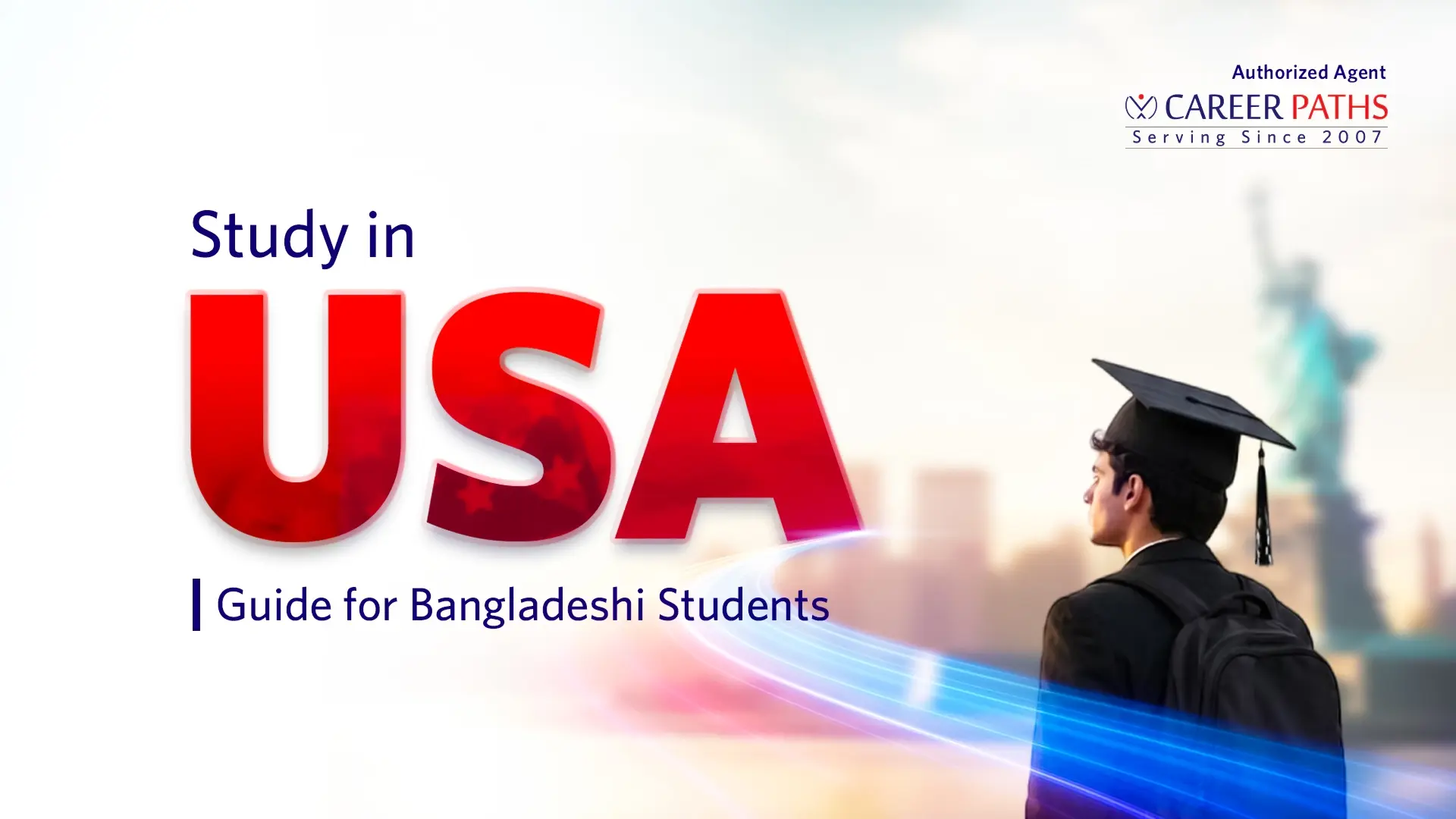
The United States offers a wide range of higher-education options for international students. These include public universities, private universities, liberal arts colleges, community colleges, and specialised institutions.
U.S. undergraduate education is often flexible. Students can take courses in different subjects alongside their major. Each university sets its own credit, major, admission, and graduation requirements. The United States hosted 1,177,766 international students in 2024/25, according to Open Doors 2025. Bangladesh recorded 20,156 students, an increase of 17.9% from the previous academic year.
This guide focuses on the 2027 entry. It covers study options, admission requirements, costs, funding, work opportunities, and student visas. Rules can change. Always check the latest information from your university and the official U.S. government websites before paying fees or making travel arrangements.
Why Study in the USA?
- A wide choice of institutions: The U.S. higher-education system has thousands of colleges and universities. Students can choose from public and private universities, liberal arts colleges, community colleges, and specialised institutions. Compare them based on your programme, academic requirements, total cost, location, funding options, and personal priorities.
- Flexible undergraduate education: An undergraduate degree normally combines major courses with classes in other subjects. Students can also take electives and explore different academic areas. Major requirements and the timing of major declaration vary by institution. A bachelor’s degree usually takes about four years of full-time study.
- Research opportunities: Research opportunities differ by university, programme, and study level. Some institutions offer undergraduate research, lab work, and faculty-led projects. Graduate programmes may offer research assistantships, fellowships, tuition support, or stipends, depending on the programme.
- Different teaching methods: U.S. courses may include lectures, seminars, lab work, presentations, projects, papers, quizzes, and exams. Assessment varies by course. Students should expect regular coursework and participation, not just a final exam.
- Campus support: SEVP-certified schools have Designated School Officials, or DSOs. They help eligible international students with immigration-related student-status matters. Many universities also offer international-student advising, academic support, career services, student organisations, and other campus services. Specific facilities vary by institution.
- Practical training: Eligible F-1 students may qualify for practical training related to their field of study. The main options are Curricular Practical Training, or CPT, and Optional Practical Training, or OPT. These programmes have specific eligibility and authorization requirements. They are not automatic benefits of an F-1 visa.
Programs and their duration in the USA
- Associate degree: An associate degree usually takes about two years. Community colleges commonly offer these programmes. Some students transfer from a community college to a four-year institution. This is often called the 2+2 model. Transfer is not automatic. Students must check credit-transfer and admission requirements with the receiving university.
- Bachelor’s degree: A bachelor’s degree usually takes about four years of full-time study. Students complete a specified number of credits and usually take courses both within and outside their major.
- Master’s degree: Master’s programmes vary in length. Many take one to two years, depending on the programme and institution.
- Doctoral degree: Doctoral programmes can take several years. Duration depends on the field, research requirements, programme structure, and the student’s progress. Some doctoral programmes provide assistantships, fellowships, tuition support, or stipends. Funding is programme-specific.
- Certificates and short courses: Certificate and short-term programmes vary in length and purpose. They may focus on English, professional skills, or specialised academic areas. Students who need F-1 status should confirm with the institution that the specific programme is eligible for F-1 enrollment before applying.
English-Language Requirements to Study in the USA
U.S. universities set their own testing requirements.
- Common English-language tests include:
- TOEFL iBT
- IELTS Academic
- PTE Academic
- Duolingo English Test
Accepted tests and minimum scores vary. Some universities also allow English-language test waivers under specific conditions. For undergraduate admission, SAT and ACT policies vary by university and programme. Some institutions are test-optional, while others require or recommend scores.
Graduate programmes may require the GRE, GMAT, or another test. Some programmes have made these tests optional or removed them. For 2027 entry, check the official requirements for each programme. Do not rely on a general university statement if your department has separate requirements.
Acadmic Intakes in the USA for International Students
There is no single U.S. national intake system.
Many universities offer:
- Fall: Usually begins in August or September and is the main entry period at many institutions.
- Spring: Usually begins in January. Not every programme accepts Spring applicants.
- Summer: Offered by some institutions and programmes. Availability varies.
Deadlines also vary. Some universities use fixed deadlines, while others offer rolling admission. Scholarship and admission deadlines may be different.
For Fall 2027, begin preparation at least 12–18 months in advance where possible, particularly for undergraduate applications with early admission or scholarship deadlines.
What Should You Consider When Choosing a University in the USA?
The QS World University Rankings 2027 include several highly ranked U.S. universities, including MIT, Stanford, Harvard, Caltech, Yale, and Johns Hopkins.
However, rankings should not be the only basis for choosing a university.
Consider:
- Programme curriculum
- Admission requirements
- Accreditation
- Total cost
- Scholarships and funding
- Location
- Housing
- Research opportunities
- Career services
- Campus environment
- Start term
- International-student support
A university’s overall ranking does not necessarily reflect the specific programme you plan to study.
Cost of Studying in the USA
There is no single national tuition rate for U.S. universities.
Your total budget may include:
- Tuition
- Mandatory fees
- Housing
- Food
- Health insurance
- Books and supplies
- Transportation
- Personal expenses
Actual costs vary by institution and location. Always use the university’s official cost-of-attendance information when preparing your budget. At public universities, international students generally do not qualify for resident tuition rates. The exact tuition structure varies by institution.
Private universities set their own tuition and fees. Some may charge high tuition, while their financial-aid policies may also differ. Community colleges often have lower tuition than four-year institutions. They can provide a lower-cost route into a bachelor’s degree, particularly when transfer arrangements are available.
Do not assume that a scholarship will cover all expenses. Many awards cover only part of tuition or living costs.
Your Form I-20 contains the school’s estimated costs for the programme. During the visa process, you may be asked to provide evidence showing how you will pay your educational, living, and travel expenses.
Working While Studying
F-1 employment rules are specific.
On-Campus Employment
Eligible F-1 students may generally work up to 20 hours per week in qualifying on-campus employment while school is in session. Different rules may apply during official breaks. Off-campus employment generally requires separate authorization. Speak with your DSO before beginning employment and follow the required procedures.
Curricular Practical Training
CPT is practical training that is an integral part of an established curriculum. It may include qualifying internships, cooperative education, or other practical training connected to the programme. The applicable F-1 requirements and authorization must be followed.
Optional Practical Training
OPT provides temporary employment directly related to an eligible F-1 student’s field of study. Eligible F-1 students may generally receive up to 12 months of OPT at each qualifying education level, subject to applicable requirements. Any pre-completion OPT used reduces the available 12-month period.
STEM OPT
Students with qualifying STEM degrees may be eligible for a 24-month STEM OPT extension after post-completion OPT. Additional requirements apply. The employer must be enrolled in E-Verify. The training plan must meet STEM OPT requirements and be documented in Form I-983.
H-1B
Some graduates later seek employer-sponsored H-1B status. This is a separate immigration classification. H-1B eligibility, employer requirements, and applicable numerical limits or selection procedures apply. Moving from OPT to H-1B is not automatic.
F-1 Student Visa
Bangladeshi students studying at U.S. colleges or universities generally apply for an F-1 student visa if their programme qualifies for F-1 status.
The general process is:
- Apply to a SEVP-certified school.
- Receive admission.
- Receive Form I-20.
- Pay the I-901 SEVIS fee.
- Complete the DS-160.
- Pay the applicable visa application fee.
- Schedule and attend the visa interview when required.
- Provide the requested supporting documents.
Admission to a U.S. university does not guarantee visa issuance. The visa application is a separate process.
Current Visa Fees and Bangladesh-Specific Information
The I-901 SEVIS fee for F and M students is $350. The nonimmigrant visa application processing fee for an F student visa is $185. Fees can change, so verify the amount before payment.
For Bangladeshi nationals, the Department of State’s current reciprocity schedule lists the F-1 visa as:
Reciprocity fee: None
Entries: Multiple
Validity: 60 months
Visa validity is different from the period of authorized stay in the United States.
Visa Integrity Fee
Federal law established a Visa Integrity Fee for the issuance of nonimmigrant visas. The implementation and payment procedure should be verified through the latest Department of State and DHS instructions. Do not add this fee to the F-1 visa budget unless the relevant U.S. government agency has confirmed that it is being collected and has published the applicable procedure.
Bangladesh-Specific Visa Information: B1/B2 Visa Bond
A separate visa-bond programme applies to nationals of certain countries seeking B1/B2 visitor visas. Bangladesh is included. Affected applicants must post a bond of $5,000, $10,000, or $15,000, with the amount determined during the visa process. This requirement applies to the specified B1/B2 programme, not to F-1 student visas.
Documents for the Visa Process
The exact documents required can vary. Students should prepare the documents requested by the Department of State and the U.S. Embassy or Consulate handling their application.
These may include:
Valid passport meeting U.S. visa validity requirements
- Form I-20
- DS-160 confirmation
- Visa appointment information
- I-901 SEVIS fee receipt
- Visa fee payment information
- Academic records
- Required test scores
- Scholarship or assistantship documents
- Evidence of financial resources
The Department of State may request additional documents. Applicants should be ready to explain their study plans and how they will cover their education and living costs. They may also need to show their academic preparation and intent to leave the United States after completing their studies.
Online-Presence Review
F, M, and J visa applicants are subject to online-presence review. The Department of State instructs applicants to set their social-media profiles to “public” or “open” for vetting. Follow the latest Department of State instructions during the visa process.
Visa Interview and Entry
Interview appointment waiting times vary by location, season, and visa category. Students should therefore apply early.
In Bangladesh, the U.S. Embassy in Dhaka provides visa services. Applicants should follow its current instructions. New F and M student visas can be issued up to 365 days before the start date of the course. However, new students cannot enter the United States more than 30 days before the programme start date.
A visa does not guarantee admission to the United States. U.S. Customs and Border Protection determines whether a traveler may be admitted at the port of entry under applicable immigration rules.
Step-by-Step Plan for Fall 2027
Choose your programme: Decide on your intended degree, field, study level, and preferred start term.
- Research universities: Compare academic requirements, curriculum, tuition, living costs, scholarships, location, and student support.
- Check tests: Confirm English-language, SAT, ACT, GRE, GMAT, or other programme-specific requirements.
- Prepare documents: Depending on the programme, you may need transcripts, certificates, test scores, essays, recommendation letters, a CV, a portfolio, and financial documents.
- Submit applications: Follow each university’s official application instructions. Check admission and scholarship deadlines separately.
- Review funding options: Compare scholarships, assistantships, fellowships, institutional aid, and personal funding requirements. Check whether funding applications have separate deadlines from admission applications.
- Obtain your I-20: After admission, follow the university’s instructions for accepting the offer and providing the information required for Form I-20 issuance.
- Complete the visa process: Pay the required SEVIS fee, complete the DS-160, pay the visa application fee, and follow the U.S. Embassy’s current instructions.
- Prepare for departure: Arrange accommodation, insurance if required, travel, university registration, and arrival arrangements. Keep your important documents accessible during travel.
Career Paths in Bangladesh
Career Paths helps Bangladeshi students plan their U.S. study journey with clarity and confidence. Get guidance on choosing a university and programme. Plan your application step by step. Explore funding options. Prepare for the visa process.
With structured guidance, you can understand your options, stay organized, and prepare your application with confidence.
Ready to plan your U.S. study journey? Start with Career Paths and take your next step with confidence
Final Checklist
Before applying, check each university’s official website for programme requirements, deadlines, tuition, scholarships, and estimated living costs. Prepare your academic and passport documents early. Arrange any required English or standardised test scores in advance.
After admission, carefully review your Form I-20 and funding documents. Then pay the SEVIS fee and complete the DS-160 and student visa process. Follow official U.S. government instructions throughout. Before travelling, check your visa validity, entry requirements, and any Bangladesh-specific requirements.