












Apply to Study MBBS


Study MBBS Abroad from Bangladesh
Career Paths is the most reliable study abroad consultancy firm in Bangladesh. Since 2007, Career Paths has been holding a reputation for providing top-notch consultation, university admission, and visa services to Bangladeshi Students. When it comes to studying MBBS abroad, Career Paths has the highest number of MBBS admission and visa success rates in Bangladesh.
Why Choose Career Paths to Study MBBS Abroad?
Since 2007, Career Paths is the most trusted & reliable Student Consultancy firm in Bangladesh where it has made trusted partnerships with 20+ best countries universities worldwide. Our expert Counselors and Team members have made Career Paths the most reliable consultancy firm in Bangladesh. Students will get the latest news regularly about education, scholarships, admission, and visa procedures.
Career Paths is the most preferred Student Consultancy firm in Bangladesh, and it has been proven by students’ reviews & recommendations. Transparent and very fast admission and visa procedure, along with helping Students in selecting the most suitable countries and universities of those countries, helped Career Paths in earning huge trust from Students. Career Paths achieved huge positive reviews from the best international universities around the world due to their hard work for students.

Entry Requirements & Admission Process
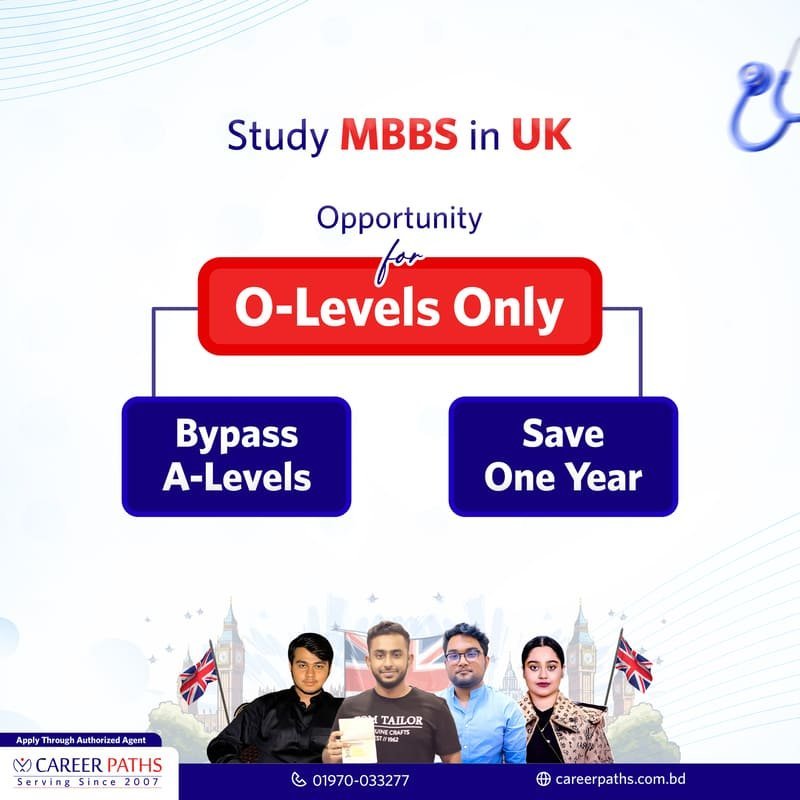
MBBS is one of the most preferred subjects in Bangladesh. Due to very high competition, many students can not get admitted to Local Institutions. Studying MBBS abroad will be a great choice for them due to easy admission process, global recognition, and Worldwide job opportunities. Normally, HSC, A-Level (12 Grade) Student with good academic grades in Science Background can apply for MBBS abroad. Additionally, O-Level, AS-Level and SSC students with good grade have a great opportunity to bypass A-level or HSC and get direct route to MBBS Degree abroad.
Universities from UK, USA, Canada, Australia, Europe has different academic and English Proficiency Requirements for Bangladeshi Students. Let’s see some of the basic academic requirements below to get admission.
General Entry Requirements for MBBS Admission:
- SSC/HSC/O-level/A-Level MBBS with a minimum GPA of 3.50 out of 5.00 or equivalent (Depending on the Universities and programme)
- IELTS Requirement: 5.5 to 6.5 (Depending on the universities & Programme)
Studying MBBS in Malaysia
MBBS is one of the most competitive degree programs in Bangladesh. Every year, a large number of capable students fail to secure a seat in public medical colleges due to limited capacity and intense competition. As a result, studying MBBS abroad, especially in Malaysia has become a popular and practical alternative for Bangladeshi students.
Malaysia is well known for its English-taught medical programs, internationally recognised degrees, comparatively affordable tuition fees, and a simpler admission process compared to many Western countries.
Who Can Apply for MBBS in Malaysia?
Bangladeshi students from different academic backgrounds can apply, provided they have completed secondary and higher secondary education with a science background.
Eligible qualifications include:
- SSC/Dakhil & HSC/Alim (Science): a minimum GPA of 3.50 out of 5.00 or equivalent (Depending on the Universities and programme)
- O-Level & A-Level: 5Bs each in Biology, Chemistry, Physics and Mathematics / Additional Mathematics and another subject at school level or its equivalent in O-Level and minimum BBB / ABC / AAC in Biology, Chemistry and Physics or Mathematics in A-Level.
- International Baccalaureate (IB): 30 points total. Minimum 2 science subjects or Mathematics at Higher Level (HL), and 1 science subject at Standard Level (SL) Minimum score of 4 in each science/math subject.
- O-Level with AS-Level: Through a foundation/Pre-Medical Program.
- English Language Requirements: IELTS: 5-6.5 depending on the University, TOEFL: 60-92 depending on the University, PTE: 63 (IMU)
Studying MBBS in the UK
- SSC/Dakhil & HSC/Alim (Science): Minimum average grade 80%/A+, and 80%/A+ in Chemistry/Biology.
- A Level: a minimum of grades ABB, including Chemistry or Biology.
- IB: a minimum of 34 points overall, to include 3 HL subjects. You must achieve at least an H6 in biology or chemistry but have taken both and achieved at least an H5 in the other.
- English Language Requirements: IELTS: 5.5 (5.5)-7 (6.5) depending on the University, TOEFL: 100 (University of Aberdeen), PTE: 50 (50), Oxford ELLT (OIETC): 8.0 (University of Aberdeen)

Studying MBBS in Europe
Who Can Apply for MBBS in Ireland?
- A Level and O Level: a minimum of three A Level subjects with minimum grades of AAB. A minimum of six subjects at GCSE O Level, which must include a minimum Grade 4 / C in English and Mathematics.
- English Language Requirements: IELTS: 6.5 (6). TOEFL is also accepted.
Study MBBS in Schengen Country Bulgaria
- A Level/HSC/Alim: 62% as an average result in biology and chemistry.
- English Language Requirements: IELTS: 5 (Writing 5, NBLT 4.5).
Who Can Apply for MBBS in Cyprus?
- SSC/Dakhil & HSC/Alim (Science): Minimum average grade 80%/A+, and 80%/A+ in Chemistry/Biology.
- A Level: a minimum of grades ABB, including Chemistry or Biology.
- IB: a minimum of 34 points overall, to include 3 HL subjects. You must achieve at least an H6 in biology or chemistry but have taken both and achieved at least an H5 in the other.
- English Language Requirements: IELTS: 5.5 (5.5), PTE: 50 (50).
Document Checklist for MBBS Admission
Document Checklist for Admission in Malaysia:
- All academic certificates & transcripts
- Passport (all pages with the green cover), 18 months validity recommended
- IELTS/PTE/TOEFL
- CV/Resume
- Passport Photo (35*45 mm, White background)
Document Checklist for Admission in the UK:
- All academic certificates & transcripts
- Passport (Information Pages)
- IELTS/PTE/TOEFL
- CV/Resume
- UCAT (Particular Universities/Medical Schools)
Document Checklist for Admission in Europe:
- All academic certificates & transcripts
- Passport (Information Pages)
- IELTS/PTE/TOEFL
- CV/Resume
Know About the Entrance And License Exam
Know About Entrance Exam of UCAT
What is the UCAT?
The University Clinical Aptitude Test (UCAT) is an admissions test used primarily in the UK, Australia, and New Zealand for entry into undergraduate medical (MBBS) and dental programmes. It assesses aptitude and cognitive skills, not science knowledge.
Countries Using UCAT
- UK
- Australia
- New Zealand
(Some universities in other regions may also accept it.)
UCAT Structure (2025/2026 Format)
Section | Number of Questions | Time | Scoring |
Verbal Reasoning (VR) | 44 | 22 min | 300 – 900 |
Decision Making (DM) | 35 | 37 min | 300 – 900 |
Quantitative Reasoning (QR) | 36 | 26 min | 300 – 900 |
Situational Judgement Test (SJT) | 69 | 26 min | Band 1–4 (UK) / numeric 300–900 (ANZ) |
Total Cognitive Score: 900 – 2700 (sum of VR + DM + QR)
SJT Score: reported separately as a band (Band 1 = strongest) or numeric (in ANZ scoring).
What Is a “Good” UCAT Score Now?
- A high competitive score often falls around 1800-2000
- An interesting factor is that most of the UK universities don’t require any particular UCAT score.
Is it possible to get admission in the UK and around Europe without UCAT?
Definitely possible. Several universities and medical schools in the UK and around Europe don’t require a UCAT score.
Know About Entrance Exam of MCAT
What is the MCAT?
The Medical College Admission Test (MCAT) is the standardised exam required for medical school admission in the United States and accepted in some other countries.
It is used for entry into graduate medical programs (MD) rather than undergraduate MBBS.
Countries Using MCAT
- United States
- Canada
- Some Caribbean medical schools
- Some universities in Asia and the Middle East
MCAT Structure (Current Format)
The MCAT is a 7.5-hour computer-based exam.
It has 4 sections:
- Chemical and Physical Foundations of Biological Systems
– General Chemistry, Physics, Organic Chemistry - Critical Analysis and Reasoning Skills (CARS)
– Reading comprehension and reasoning - Biological and Biochemical Foundations of Living Systems
– Biology and Biochemistry - Psychological, Social, and Biological Foundations of Behavior
– Psychology and Sociology
MCAT Scoring
- Each section: 118–132
- Total score range: 472–528
- Average accepted score for competitive schools: ~510–515+
- Results available ~1 month after exam
- MCAT scores are generally valid for 2–3 years
Know About License Exam of USMLE
The United States Medical Licensing Examination (USMLE) is a rigorous, multi-step assessment required for medical licensure in the United States. Designed to evaluate a physician’s competency in applying medical knowledge, clinical skills, and patient care principles, the USMLE is a critical milestone for both U.S. and international medical graduates (IMGs) pursuing residency and practice in the U.S.
The exam is divided into three main steps:
- Step 1: focuses on foundational biomedical sciences, testing knowledge of anatomy, physiology, pharmacology, and pathology in a multiple-choice format. Historically scored as pass/fail (since 2022), it remains a key factor in residency program selection.
- Step 2: consists of two parts: Clinical Knowledge (CK), which assesses diagnostic and clinical management skills, and Clinical Skills (CS), which was discontinued in 2021 and replaced by other competency evaluations like the USMLE Step 2 CS OSCE (if required by specific states or institutions).
- Step 3: is the final assessment, emphasizing patient management, diagnosis, and treatment in both outpatient and inpatient settings. It includes computer-based case simulations (CCS) to evaluate decision-making in real-world scenarios.
The USMLE is jointly administered by the National Board of Medical Examiners (NBME) and the Federation of State Medical Boards (FSMB). Successfully passing all steps is mandatory for obtaining a medical license and securing a residency position through the National Resident Matching Program (NRMP).
Preparation for the USMLE is intensive, often requiring months of dedicated study, question banks (e.g., UWorld), and practice exams. The exam’s difficulty and high stakes make it one of the most challenging medical licensing tests globally. For IMGs, additional requirements like ECFMG certification add another layer of complexity. Ultimately, the USMLE ensures that physicians meet a standardized level of competence before entering the U.S. healthcare system.
Interview Process
Universities and medical schools use two types of interview evaluation — Traditional and MMI.
Medical Schools That Use General (Traditional) Interviews
A general interview typically involves:
- 1–3 interviewers (faculty members, doctors, admissions tutors)
- 20–45 minutes duration
- Questions about motivation, academics, work experience, and ethical understanding
- A conversational format rather than rotating stations
This format is more in-depth and allows interviewers to explore your personality and commitment to medicine over a longer discussion.
What is the MMI Interview for MBBS Admission?
For many medical schools in countries such as the UK, Australia, and Malaysia, academic excellence alone is not enough. Universities want to assess whether a student truly possesses the qualities required to become a competent, ethical, and compassionate doctor. This is where the Multiple Mini Interview (MMI) comes in.
The MMI (Multiple Mini Interview) is a modern medical school interview format designed to evaluate a candidate’s non-academic abilities. Unlike traditional panel interviews, the MMI consists of several short interview stations, each focusing on a different skill or scenario.
How Does the MMI Format Work?
Typically, an MMI includes:
- 6–10 short stations
- 5–8 minutes per station
- A new interviewer at each station
- A different question or scenario at every station
At each station, candidates are given a prompt or situation to respond to. After the allocated time ends, they move to the next station and start fresh.
This format ensures fairness and reduces bias, as performance is assessed by multiple interviewers rather than a single panel.
What Do Medical Schools Assess in MMI?
The MMI focuses on qualities essential for future doctors, such as:
- Communication skills
- Ethical reasoning
- Critical thinking
- Empathy and compassion
- Problem-solving ability
- Teamwork and leadership
- Professionalism
- Ability to handle pressure
Medical schools believe these attributes are just as important as academic results.
Types of Questions You May Face
MMI stations can include:
1️⃣ Ethical Scenarios (medical or non medical)
Example:
A patient refuses life-saving treatment. What would you do?
These questions test your ability to apply ethical principles such as autonomy, beneficence, and confidentiality.
2️⃣ Situational Judgement
Example:
You see a teammate cheating in a group project. How would you handle it?
These assess professionalism and integrity.
3️⃣ Communication Role-Play
You may be asked to explain a medical concept to a non-medical person or comfort a distressed “patient” (actor).
4️⃣ Personal Motivation Questions
Example:
Why do you want to study medicine?
Interviewers look for genuine motivation, not memorized answers.
5️⃣ Problem-Solving or Logical Tasks
Short puzzles or policy-based discussions to evaluate analytical thinking.
Why is MMI Important?
Medical schools use MMI because:
- It provides a more holistic assessment
- It reduces interviewer bias
- It evaluates real-life decision-making
- It predicts future professionalism and communication skills
Visa Processing Overview
Malaysia Student Visa Process
Malaysia has a centralised and relatively straightforward visa system for international students.
After receiving an offer letter from a Malaysian university, the institution applies for the student’s Visa Approval Letter (VAL) through the Education Malaysia Global Services (EMGS).
Main Steps
- Receive university offer letter
- University submits visa application through EMGS portal
- Student receives Visa Approval Letter (VAL)
- Apply for Single Entry Visa at the Malaysian embassy
- Travel to Malaysia and complete medical screening and student pass endorsement
Processing Time
Approximately 4–8 weeks
Malaysia is popular among Bangladeshi students because of simpler visa procedures, affordable costs, and English-taught programs.
United Kingdom (UK) Student Visa Process
Students admitted to UK universities apply for the UK Student Visa.
Once admitted, universities issue a Confirmation of Acceptance for Studies (CAS) number, which is required for the visa application.
Main Steps
- Receive university offer
- Obtain CAS letter from the university
- Submit online visa application
- Pay visa fee and Immigration Health Surcharge (IHS)
- Attend biometric appointment at VFS Global
- Receive visa decision
Processing Time
Usually 3–4 weeks from Bangladesh.
UK student visas also allow part-time work during studies and the Graduate Route Visa, which permits 2 years of post-study work.
United States Student Visa Process
Students planning to study in the United States usually apply for the F‑1 Student Visa.
The visa process includes both documentation and a mandatory visa interview at the U.S. embassy.
Main Steps
- Receive Form I-20 from the university
- Pay SEVIS Fee
- Complete DS-160 visa application form
- Schedule visa interview
- Attend interview at the U.S. Embassy Dhaka
Processing Time
Varies depending on interview availability, but typically 2–6 weeks.
US visas focus strongly on:
- Academic preparation
- Financial ability
- Intent to return after studies.
Ireland Student Visa Process
International students admitted to Irish universities apply for a Ireland Long Stay D Visa.
Ireland has become a popular destination due to English-language programs and strong job opportunities in technology and healthcare sectors.
Main Steps
- Receive university offer letter
- Pay tuition deposit
- Submit visa application through the AVATS online portal
- Submit documents and biometrics at VFS Global
Processing Time
Usually 4–8 weeks.
After graduation, students may qualify for the Third Level Graduate Programme, allowing up to 2 years of work.
Cyprus Student Visa Process
Cyprus offers relatively accessible visa procedures and has become a growing study destination for Bangladeshi students.
Main Steps
- Receive admission letter from a Cypriot university
- Pay part of the tuition fee deposit
- Submit visa application through the Cyprus High Commission Dhaka or authorised centres
- Provide medical tests, financial proof, and police clearance
Processing Time
Typically 3–6 weeks.
Cyprus is attractive due to lower tuition costs, simplified admission procedures, and growing international programs.