Introducation
The journey toward achieving an MBBS (Bachelor of Medicine and Bachelor of Surgery) degree test in Bangladesh is one of the country’s most Competitive, as well as difficult and demanding academic phases, which is centrally conducted by the Directorate General of Medical Education (DGME). It is the single, high-stakes gatekeeper for all medical colleges and among the most competitive in the country, characterized by an exceptionally high applicant-to-seat ratio.
The admission test for the 2025–26 academic session for government and private medical colleges across the country will be held on December 12. Based on the 2025–2026 admission data according to the Directorate General of Medical Education (DGME) circular, there will be 5,100 seats across 37 government medical colleges, while 66 private medical colleges have 6,001 seats, including the newly approved ones. The total number of candidates for the 2025-2026 MBBS session is not yet available, but the seats in government and private medical colleges have been cut by 572 from this year. Last year, a fierce ratio of roughly 25 candidates per seat, despite a technical pass rate (scoring 40/100 or more) of around 45.62%.
This medical admission guide provides a comprehensive A-to-Z breakdown based on the latest official circulars of the MBBS requirements, test format, and strategic preparation required to navigate this tough competition and secure one of the coveted MBBS seats in the 2026 session.
Eligibility Requirements for MBBS Admission Test
Meeting the minimum eligibility criteria is the first essential step. The requirements vary slightly for Bangladeshi and international students.
Requirements for Bangladeshi Students
Candidates must be permanent residents of Bangladesh and meet the following academic conditions:
Criteria |
Requirements (Based on 2025–2026 Circular) | |
|---|---|---|
Academic Group |
Must have passed both SSC/Equivalent and HSC/Equivalent from the Science Group with subjects included Physics, Chemistry, and Biology. | |
Passing Years |
Candidates interested in participating in the admission test for the 2025-2026 academic year must have passed the HSC/'A' Level/equivalent examination in the year 2024 or 2025. Students who passed the SSC/'O' Level/equivalent examination before 2022 will not be considered eligible to apply. | |
Minimum Aggregate GPA |
Combined GPA (SSC/Equivalent and HSC/Equivalent) must be at least 8.5; however, the Individual GPA in both SSC/Equivalent and HSC/Equivalent must be at least 4.00 separately. | |
Backward/Tribal Communities and Non-Tribal Candidates of Hill Tracts |
For candidates belonging to backward communities (i.e., all tribal candidates) and non-tribal candidates of the Hill Tracts districts, the total GPA obtained in both the SSC/'O' Level/equivalent and HSC/'A' Level/equivalent examinations must be at least 8.00. However, if the GPA in any single examination is less than 3.50, they will not be considered eligible to apply. | |
Biology Requirement |
Must have a minimum GPA of 3.50 in Biology in the HSC/Equivalent examination for all categories of candidates. | |
Second Time Applicants |
(a) Students who sat for the test previously (HSC passed in 2024) are eligible but will face a deduction of 3 marks from their total score. (b) Students who are already admitted to the Government Medical College, Dental College, or Dental Unit in the immediate preceding academic session (2024-2025), a penalty of 5 (five) marks will be deducted from their overall total score when calculating their final position in the merit list for the current admission test. | |
Requirements for International Students (Foreign Nationals)
International students applying for non-government medical colleges must seek an equivalency certificate from the Director General of Health Services (DGHS), and their admission test will be continued into the respective medical colleges/dental colleges/dental units till February 19, 2026.
- Academic Background: Must have passed the equivalent of SSC (O-Level/10th Grade) and HSC (A-Level/12th Grade) with subjects included– Physics, Chemistry, and Biology.
- Minimum Aggregate GPA: Combined GPA (O-Level plus A-Level equivalent) must be at least 7.00 on a scale of individual GPA 5. However, a GPA score of less than 3.50 points in any single exam will not be considered.
- Minimum GPA in Biology: Must have a minimum GPA of 3.50 in Biology in the A-Level/12 class or equivalent examination.
- Application Procedure: Applications are typically submitted online via the official DGME portal.
- All original certificates, mark sheets, and relevant documents should be submitted to the office of the principal of the respective medical colleges/dental colleges/dental units of Bangladesh at the time of admission.
[Special Note for both Bangladeshi and Non-Bangladeshi candidates: Fabrication of any documents in the admission process is subject to cancellation of admission, which will be punishable under law. If any information or document, or procedure is found fictitious in the future, the admission will be void immediately, and the Ministry of Health & Family Welfare of Bangladesh will not bear any responsibility, says the official DGME circular.]
MBBS Admission Test Format
The admission test for the MBBS and BDS courses in all government and private medical colleges, as well as dental colleges/dental units across the country, will be held simultaneously using a single, uniform question paper.
- Type of Exam: Multiple Choice Questions (MCQ).
- Total Time: 1 hour and 15 Minutes.
- Written Part: There will be a total of 100 questions (based on the HSC or equivalent syllabus), with each question carrying 01 mark, totaling 100 marks.
- Subject-wise mark distribution:
Subjects |
Marks |
|---|---|
Physics |
15 marks |
Chemistry |
25 marks |
Biology |
30 marks |
English |
15 marks |
General Knowledge |
15 marks |
Total |
100 marks |
- Marking Scheme: 1 mark for every correct answer.
- Negative Marking: 0.25 marks deducted for every wrong answer.
- Pass Mark: Candidates scoring less than 40 marks in the written test will be considered unsuccessful and ineligible for admission.
- The final merit list is prepared based on combining the Admission Test score and the GPA scores from SSC/Equivalent and HSC/Equivalent examinations. Showing through a table below:
Component |
Calculation Formula |
Maximum Marks |
|---|---|---|
Admission Test (MCQ) |
100 Question x 1 mark each |
100 |
SSC/Equivalent GPA |
GPA obtained in the SSC or equivalent examination is multiplied by 8 |
40 (Highest) |
HSC/Equivalent GPA |
GPA obtained in the HSC or equivalent examination is multiplied by 12 |
60 (Highest) |
Syllabus Overview
The syllabus for the MBBS admission test is based entirely on the academic content of the HSC/Equivalent Science curriculum.
- The focus is primarily on the main textbooks published by the National Curriculum and Textbook Board (NCTB) for the HSC level.
- The subjects tested are: Biology, Chemistry, Physics, English, and General Knowledge.
Subject |
Focus Area |
|---|---|
Biology |
Botany & Zoology (HSC Textbook: Highly critical) |
Physics |
1st & 2nd Paper (Concepts, Formulas, Minimal Math) |
English |
Grammar, Vocabulary, Synonyms, Antonyms, Prepositions |
General Knowledge |
History of Bangladesh (War of Liberation), Geography, Current Affairs, International Issues, Health Sector |
[Special Note: It is to be noted that the materials are based on the above, but not limited to the listed ones.]
MBBS Admission Test Preparation Strategy
Subject-wise Preparation Plan
- Biology (30 Marks): This is the most crucial subject. Focus intensely on the HSC Zoology and Botany textbooks. Memorize diagrams, cycles, classifications, and scientific names. Ensure every line of the Biology textbook is covered, as questions are often fact-based and directly quoted.
- Chemistry (25 Marks): Prioritize Organic Chemistry and Quantitative Chemistry. Master the concepts of chemical reactions, calculations, and formulas. Practice MCQs that test logical reasoning over complex math.
- Physics (15 Marks): The questions usually focus on fundamental concepts and short, formula-based problems. Focus on theoretical clarity, units, dimensions, and graphical representations rather than lengthy derivations.
- English (15 Marks): English marks are easy to secure but often neglected. Focus on core grammar rules (voice, narration, right form of verbs) and enrich your vocabulary (synonyms, antonyms). Practice previous years’ English questions extensively.
- General Knowledge (15 Marks): Dedicate a fixed time daily to current affairs and Bangladesh’s history. Special emphasis should be placed on the 1971 Liberation War and key developments in the health sector.
Study Timeline
Your preparation should be divided into phases:
- Phase 1 (Conceptual Clarity): Thoroughly revisit all HSC textbooks (Physics, Chemistry, Biology). Your goal is 100% textbook knowledge. (Approx. 2-3 months).
- Phase 2 (Practice & Test): Switch to model tests and subject-wise question banks. Start identifying weak areas and reviewing them. (Approx. 1-2 months).
- Phase 3 (Final Revision): Focus only on revising handwritten notes, key points, and the previous year’s full question papers. Stop introducing new material. (Approx. 2-4 weeks before the exam.
Daily Study Routine
A consistent, disciplined routine is non-negotiable for success in this demanding exam. Below is a suggested daily routine recommended by doctors & medical college students. You can create your own routine based on your strengths and weaknesses.
| Time Slot | Duration | Focus Area | Note |
|---|---|---|---|
| 5:00 AM – 8:00 AM | 3 Hours | Biology (New Chapter/Memorization) | Best time for deep memorization and reading. |
| 8:30 AM – 9:30 AM | 1 Hour | English & GK | Vocabulary, grammar practice, and reading a daily news summary. |
| 10:00 AM – 1:00 PM | 3 Hours | Chemistry (Conceptual Review/Problem Solving) | Focus on organic reactions and calculations. |
| 3:00 PM – 5:00 PM | 2 Hours | Physics (Formula and Theory) | Review concepts and quick practice of simple mathematical problems. |
| 6:00 PM – 7:00 PM | 1 Hour | Review of Handwritten Notes | Daily review of tough points and mistake notes. |
| 8:00 PM – 10:00 PM | 2 Hours | Model Test/Practice Test | Simulate the 1-hour exam environment (100 MCQs) |
| 10:00 PM – 11:00 PM | 1 Hour | Error Analysis | The most important part: analyze model test mistakes. |
Best Books for MBBS Admission Preparation
While the HSC Textbooks (NCTB-approved) are the primary and most authentic resources, several guidebooks are indispensable for structured MCQ practice and targeted preparation.
| Category | Recommended Resources |
|---|---|
| Core Textbooks | HSC Textbooks (Physics, Chemistry, Biology) |
| MCQ Practice | Relevant Medical Admission Question Banks (e.g. Udvash, Icon, Retina, or similar popular guides) |
| General Knowledge | A recent General Knowledge handbook specifically for medical/varsity admission. |
| English | High School Grammar books and a dedicated admission English practice guide. |
Guidelines for MBBS Admission Test Day
Final Checklist
- Admit Card: Carry a color-printed copy of your Admit Card.
- Identification: Bring a valid photo ID (e.g., HSC Registration Card or National ID Card).
- Writing Instruments: Two Black Ballpoint Pens.
- Prohibited Items: No electronic devices (mobiles, watches, calculators), books, or bags are allowed inside the exam hall.
How to Manage Stress
- Prioritize Sleep: Get at least 7–8 hours of sound sleep the night before.
- Arrive Early: Reach the examination center at least 60 minutes early to find your seat and settle down without panic.
- Stay Hydrated: Drink water, but manage intake to avoid frequent restroom breaks.
How to Fill OMR Correctly
The OMR (Optical Mark Recognition) sheet is checked by a machine, making correct filling critical.
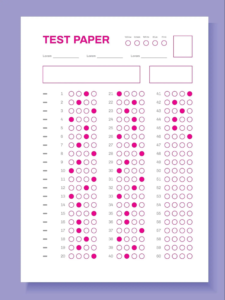
- Read Instructions: Carefully read the OMR instructions on the question paper and admit card.
- Use the Right Pen: Use only the black ballpoint pen specified by the DGME.
- Roll Number/Code: Double-check that you have correctly filled in your Roll Number and Set Code (A/B/C/D). A single mistake here can lead to automatic disqualification.
- Filling Technique: Darken the circles completely and precisely. Do not tick mark, cross, or half-fill the circles.
Detailed Fee Structure for MBBS/BDS Admission 2026 (Private & Government Medical Colleges)
For government medical colleges, an additional fee includes- Tk 50 for admission, Tk 300 for annual tuition, Tk 6,000 for internal exams, Tk200 for identity cards, and Tk 300 for library cards. The total additional fees amount is Tk 9,750, while the MBBS admission fee for private medical colleges in Bangladesh is fixed at Tk 19,44,000, and the BDS admission fee is Tk 11,00,000. Additionally, internship fees are fixed at Tk1,80,000, with a monthly tuition fee of Tk10,000. The above-mentioned statement comes after a notification published by the Ministry of Health in the year 2018, which set the MBBS admission fee at Tk16,20,000; however, in 2023, the fee was revised and raised to Tk 19,44,000.
Furthermore, the prescribed fees also apply to foreign students under the SAARC quota; however, the non-SAARC foreign students will be directed to deposit a mandatory USD 5,000 per academic year into the government treasury.
The payment structure includes: 60% of the total fees (admission and internship) must be paid at the time of admission, 20% at the first professional exam, and 20% at the third professional exam. Tuition fees are to be paid monthly, and no additional fees beyond the prescribed amounts will be allowed.
Conclusion
The path to Medical College in Bangladesh is a marathon of dedication and strategy. It is important not to let the competition intimidate you.
The performance in this one-hour and fifteen-minute admission test, combined with the impressive academic GPA, will determine further success, so trusting the preparation, remaining calm under pressure, and executing the strategy on exam day are the keys to your MBBS success.
Even if you have prepared positively and are dedicated to the MBBS admission test in Bangladesh and face a setback, remember that your dedication hasn’t gone to waste! You can still have the thrilling opportunity to pursue your medical degree by studying MBBS abroad in the always available, top-ranked, globally recognised medical colleges. To make this shift smooth, effective, and successful, Career Paths can assist you in navigating the admissions process, selecting the best international institutions, and ensuring your medical journey continues!