
Are you looking for a study destination where world-class education meets an exceptional quality of life, without the intense commercial pressure of traditional study hubs? If you want to know how a small Nordic nation consistently tops global happiness indexes while offering top-tier university degrees, you have come to the right place.
Finland has become a prime destination for Bangladeshi students seeking an affordable, safe, and highly innovative environment. Known for its stunning natural landscapes, clean air, progressive societal values, and incredibly low social hierarchy, Finland provides an academic experience focused on student well-being and practical skill development rather than memorisation.
Read the following comprehensive guide to discover everything you need to know about studying in Finland and how you can transition from Bangladesh to the happiest country in the world.
How Does the Finnish University System Work?
The higher education system in Finland is built on a distinct “dual model” consisting of two parallel sectors, each serving a different career mindset:
Traditional Research Universities: These institutions focus strictly on scientific research and academic, theoretical education. They offer Bachelor’s, Master’s, and Doctoral (PhD) pathways. If your goal is to pursue deep research, academia, or high-level corporate scientific positions, this is your path.
Universities of Applied Sciences (UAS): These focus heavily on professional development, hands-on training, and industry-specific problem-solving. Their curriculum is designed alongside actual companies to address current labour market needs. Note that while they offer Bachelor’s and Master’s degrees, they do not offer PhD tracks.
How Many Universities Are There in Finland?
Finland features a compact but highly efficient network of 14 traditional universities and 22 universities of applied sciences (UAS), hosting over 30,000 international students.
Despite the system’s small scale, Finnish research universities regularly make strong showings in the elite global rankings. In the QS World University Rankings 2026/2027 and Times Higher Education (THE) World University Rankings 2026, institutions like Aalto University and the University of Helsinki consistently place well within the top 150 globally. Because global rankings favour research-heavy profiles, the excellent UAS institutions are usually excluded, but they remain top choices for career-oriented international students.
How Do You Apply to Study in Finland?
Applying to Finnish institutions from Bangladesh is streamlined by a centralised system, making paperwork manageable if you follow deadlines carefully.
The Application Process
- Find Your Program: Use the official national portal (Studyinfo.fi) to browse English-taught courses.
- Application Windows: The primary “Joint Application” window occurs in January for programs starting in autumn (September). Some universities offer separate direct applications between late autumn and early spring.
- Submit Documents: You will need your academic certificates (HSC/Bachelor transcript), passport copy, English proficiency scores, and occasionally a motivation letter or portfolio.
- Entrance Exams/SAT: Many UAS programs require an online International UAS Exam, which tests reasoning, math, and English skills. Some traditional universities accept SAT scores instead.
Visa and Residence Permit
Once accepted, you apply for a student Residence Permit online via the Enter Finland portal. The processing time generally ranges between 1 and 2 months.
The visa success ratio for Bangladeshi students with legitimate admission, clean documents, and verifiable funding remains highly favourable, where the students must pay the processing fee (€600, approx. 92,300 BDT, according to the Finnish Immigration Service updated its processing fees) and show concrete proof of financial sustainability.
Top Finnish Universities for Bangladeshi students
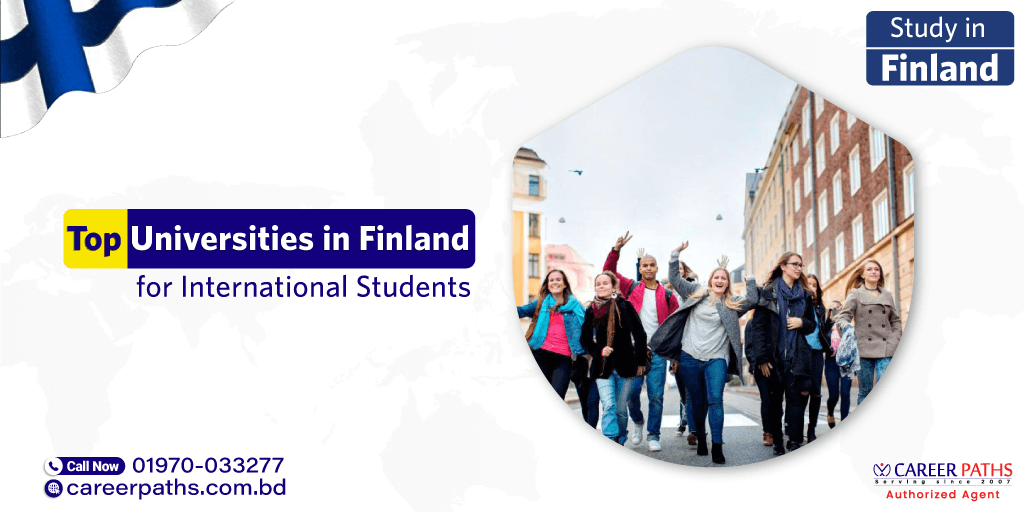
Below is the list of 15 top Finnish higher education institutions available through our agency pathways, representing the finest traditional research institutions and universities of applied sciences across the country:
University Name | Category | Main Location | Top English-Taught Programmes |
Research | Espoo (Helsinki Region) | Business, Art & Design, Data Science, Tech | |
University of Helsinki | Research | Helsinki | Medicine, Data Science, Law, Social Sciences |
Applied Sciences | Lahti / Lappeenranta | Sustainable Solutions Eng., Design, Fine Arts, IT | |
University of Oulu | Research | Oulu | 6G Telecommunications, Software Engineering |
Research | Lappeenranta / Lahti | Green Energy, Sustainability, Business | |
University of Turku | Research | Turku | Biosciences, Cybersecurity, Education |
Tampere University | Research | Tampere | Human-Technology Interaction, Computing |
University of Jyväskylä | Research | Jyväskylä | Cognitive Computing, Sports Science |
University of Eastern Finland | Research | Kuopio / Joensuu | Forestry, Environmental Science, Biomedicine |
University of Vaasa | Research | Vaasa | Industrial Management, Finance |
Åbo Akademi University | Research | Turku | Chemical Engineering, Human Rights Law |
Haaga-Helia UAS | Applied Sciences | Helsinki | International Business, Hospitality |
Tampere UAS (TAMK) | Applied Sciences | Tampere | Media & Arts, Software Engineering |
Arcada UAS | Applied Sciences | Helsinki | Big Data Analytics, International Business |
Metropolia University of Applied Sciences | Applied Sciences | Helsinki | Automation Engineering, Health Care, Business |
Which Universities are Most Popular Among Asian Students?
South Asian and Bangladeshi students tend to gravitate toward specific Finnish universities for three primary reasons: generous scholarship programs, strong employment networks in tech and business, and vibrant international student communities.
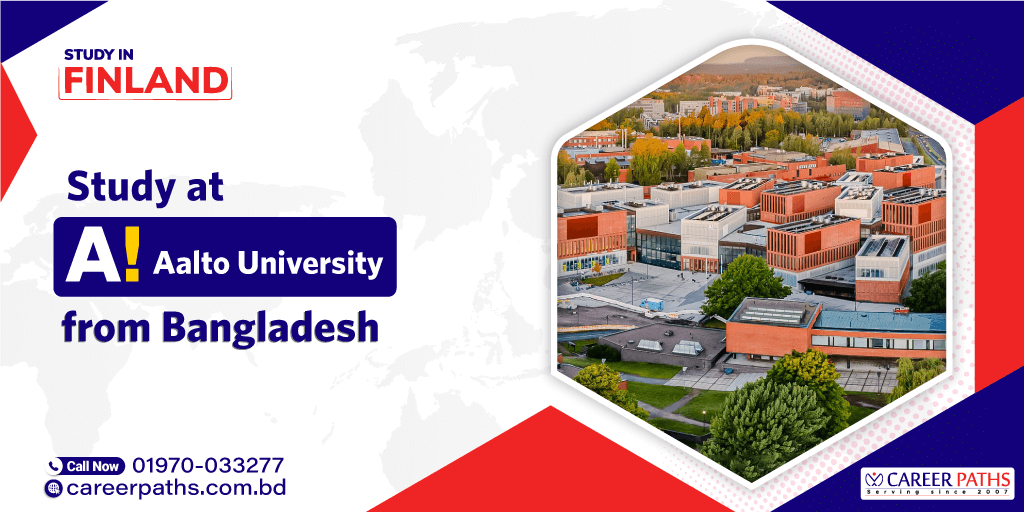
- Aalto University & University of Helsinki: These are the premier choices for ambitious students aiming for elite global research, deep tech, and data science. Aalto’s massive startup ecosystem (including Europe’s largest student-run startup hub, Aaltoes) makes it immensely popular for South Asians aiming for entrepreneurship.
- LUT University & University of Oulu: Highly favored by South Asian engineering graduates. Oulu is a global hub for 5G/6G telecommunications, while LUT is globally acclaimed for green energy and sustainability—both fields offering massive post-graduation job prospects.
- LAB University of Applied Sciences, Metropolia UAS, and Centria UAS: These applied sciences universities are incredibly popular for South Asian undergraduate and professional Master’s applicants. They offer highly practical, hands-on learning, faster integration into the local Nordic job market, and more accessible, budget-friendly tuition rates.
Do You Need to Take a Language Test to Study in Finland?
Yes, because you will be studying in Finland in an English-medium program, you must verify your English language proficiency. Most universities require an IELTS Academic score, though they generally accept TOEFL iBT, PTE Academic, or Cambridge C1 Advanced scores as well.
- For Bachelor’s Degrees: An overall IELTS score of 6.0 (with no individual band score below 5.5) is standard.
- For Master’s Degrees: An overall IELTS score of 6.5 (with no component score below 6.0) is typically expected.
Can You Study in Finland Without IELTS?
Medium of Instruction (MOI) certificates from Bangladeshi universities are rarely accepted as a standalone alternative unless you hold a degree from a native English-speaking country. Taking a recognized English proficiency test is highly recommended to secure smooth entry.
How Much Does It Cost to Study in Finland?
Tuition Fees
One of the most important costs to consider when studying in Finland is tuition. While PhD programs remain free for everyone, non-EU/EEA international students paying for English-taught Bachelor’s and Master’s degrees face annual tuition costs:
- Average Range: €8,000 to €20,000 per year. (Approx. 11.28 Lakh to 28.20 Lakh BDT per year)
[Note: Excellent students can significantly lower these costs by qualifying for university-specific merit scholarships, which often provide 50% to 100% tuition waivers.]
The minimum monthly living budget mandated by the Finnish Immigration Service requires you to show €800 per month (Approx. 1.13 Lakh BDT per month) or €9,600 per year (Approx. 13.54 Lakh BDT per year) in free funds. Realistically, your actual expenses will depend on your lifestyle and your city:
- Student Housing (e.g., HOAS, TOAS): €300 to €500 per month (Approx. 42,300 to 70,500 BDT per month) for a shared student apartment.
- Food & Groceries: €200 to €300 per month (Approx. 28,200 to 42,300 BDT per month) if you cook at home.
- Total Real-World Cost: Budget roughly €700 to €1,100 per month (Approx. 98,700 to 1.55 Lakh BDT per month); students must keep in mind that the capital region, Helsinki, is noticeably more expensive than smaller student towns like Oulu or Jyväskylä.
Special Note: All the transactions and money must be held entirely in the student’s own personal bank account. Sponsorship letters from uncles, parents, or employers are no longer accepted by Migri (The Finnish Immigration Service). Students must provide a 6-month bank statement proving the funds belong entirely to him/her.
Weather Considerations
Be prepared for a major shift from Bangladesh’s tropical climate. Finnish winters are long, dark, and snowy, with temperatures ranging from -5°C to -20°C (or lower in northern regions). However, high-quality indoor thermal heating infrastructure makes it comfortable, and the spectacular, crisp Nordic summers make the winter stretch worthwhile.
Can You Bring Your Spouse While Studying in Finland?
Finland is famously family-friendly. If you are admitted to a degree programme, the applicant’s spouse and children can apply for a family ties residence permit simultaneously with your student application. The student’s spouse is granted full working rights in Finland from day one, which can help ease financial pressure.
Can You Work Part-Time While Studying in Finland?
Yes. You are legally allowed to work up to 30 hours per week during term time, with unlimited hours during official university breaks. Typical student wages run €10 to €14 per hour (Approx. 1,415 to 1,980 BDT per hour).
What Can You Do After Studying in Finland?
Finland offers clear post-graduation pathways for international students who want to build a career in Europe.
- Post-Study Work Visa: Upon graduation, you are eligible for an extended residence permit lasting up to 2 years specifically to hunt for a job or start a business.
- Permanent Residency (PR): Time spent on a student permit counts at a half-rate toward the continuous residency requirement. To secure Permanent Residency, a graduate must transition onto a full work permit and meet the updated 2026 employment and language milestones, which takes a long time eventually. Additionally, gaining proficiency in the local language remains the ultimate catalyst for securing high-earning corporate positions within the Finnish job market.
Final Thoughts
Choosing where to pursue higher education is a life-defining decision. With its world-class academic model, unrivalled safety, family-friendly policies, and clear pathways to post-study work and permanent residency, Finland stands out as an exceptional choice for Bangladeshi students looking to build a secure future in Europe.
As an agency, we maintain direct partnerships and close ties with Finland’s top universities and leading universities of applied sciences. Take the first step toward your Nordic future today.
Get in touch with us, and let’s start planning your successful path to Finland!