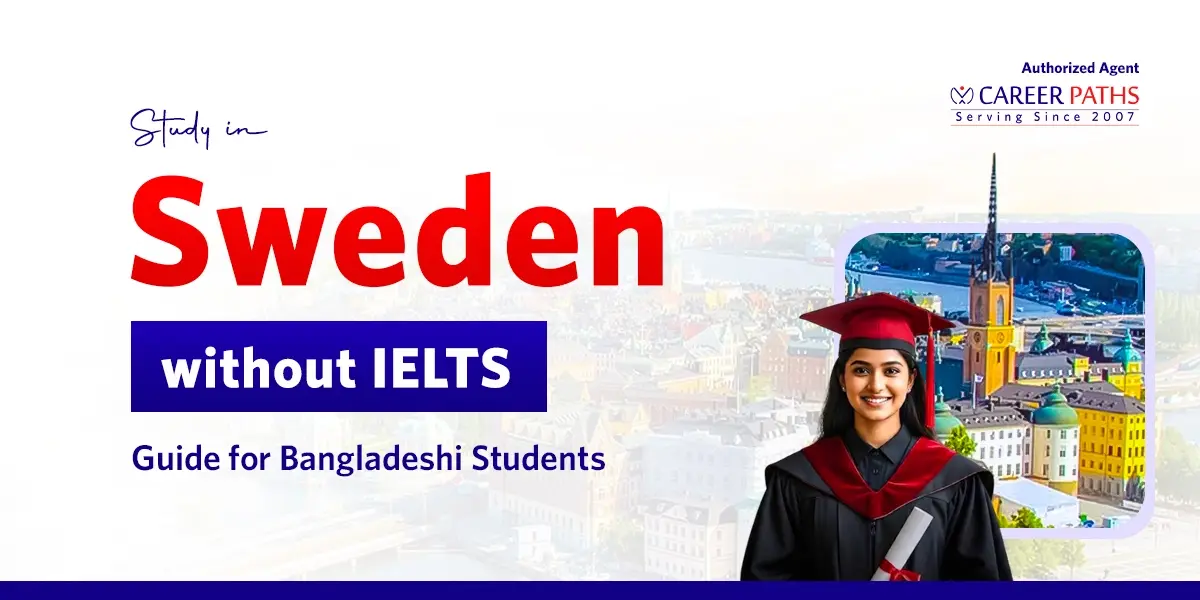
Sweden is one of the most loved study destinations for Bangladeshi students. It has world-class universities, low crime rates, and hundreds of courses taught fully in English. But one question stops many students before they even start: “Do I need IELTS to study in Sweden?”
The honest answer is that it depends on your academic background. Generally, Swedish universities do not accept a plain school or college letter as proof of English proficiency for Bangladeshi applicants. There are, however, genuine exceptions: O-Level students can use their GCSE/IGCSE English grade, English Department graduates can use their Bachelor’s degree, and MBBS graduates can use an MOI certificate. Everyone else can choose a different recognized test, such as TOEFL iBT, PTE Academic, or Cambridge English, instead of IELTS.
This guide explains whether it is possible to study in Sweden without IELTS, why Sweden is a top destination for higher education, the documents and qualifications you need, accepted alternatives to IELTS, who may qualify for an English language test exemption, and the scholarships available for international students. By the end, you will have a clear understanding of the next steps in your application process.
Why Choose Sweden for Higher Education
Sweden is known for its high-quality education system, which combines academic excellence with a balanced and student-friendly lifestyle. This supportive environment helps many international students, including those from Bangladesh, adjust smoothly within a short time. Here are some of the main reasons why thousands of Bangladeshi students choose Sweden for higher education each year:
Top universities: Lund University, KTH Royal Institute of Technology, Uppsala University, and Stockholm University are ranked among the best in the world.
English-taught programs: Sweden offers more than 1,000 programs taught fully in English, so you do not need to learn Swedish to study there.
Strong career value: Companies like Spotify, Ericsson, IKEA, and Volvo started in Sweden, which shows how strong its job market and innovation culture are.
Affordable for the value you get: Tuition fees are lower than in the UK or the USA, and many PhD programs are free, even for international students.
Work while you study: International students can work part-time during the semester and full-time during holidays.
Stay after graduation: Graduates get a 12-month residence permit to search for jobs or start a business in Sweden.
Safe and welcoming: Sweden is one of the most peaceful countries in the world, with a friendly and growing Bangladeshi student community in cities like Stockholm, Lund, and Uppsala.
Family-friendly rules: International students can bring their spouse or partner to Sweden, where they may have the right to live and work during the student’s studies.
Eligibility Criteria for Bangladeshi Students
Before applying to a Swedish university, Bangladeshi students must meet certain academic and documentation requirements. In addition to meeting the programme’s academic qualifications, you will generally need the following:
- A valid passport that remains valid throughout your study period and residence permit duration.
- Official academic transcripts and certificates, certified and issued directly by your university’s Academic Registrar or Examinations Office.
- A Statement of Purpose (SOP) and an updated CV, if required by the chosen programme.
- Letters of recommendation, only if requested by the university or programme.
- Proof of English language proficiency through an accepted test, unless you qualify for an exemption.
- Evidence that you have enough funds to cover tuition fees and living expenses during your studies.
The admission requirements vary depending on whether you are applying for a bachelor’s or a master’s programme.
Eligibility Criteria for Bachelor's Course
To get into a bachelor’s program, you need to have finished HSC/A-Level or something similar, like a Business, Commerce, or Engineering Diploma, a Vocational HSC, a Pre-University course, or a Madrasah Alim Certificate. Your Examination Certificate, Marks Sheet, and Transcript must be issued by the Board of Intermediate and Secondary Education (BISE) or the Bangladesh Technical Education Board — papers from your school or college will not be accepted. If you finished HSC after 2009, you also need a passing grade in Math, either on your HSC, or on your SSC if HSC did not include Math.
You also need to prove your English skills with an international test, because a normal HSC result from Bangladesh is not enough on its own. The only exception is for O-Level students, who can use their UK-board GCSE or IGCSE English grade instead. There is no fixed minimum GPA, but popular programs are competitive, so better grades give you a stronger chance.
Once you meet the basics above, popular programs select students competitively based on grades, so stronger HSC results improve your chances.
Eligibility Criteria for the Master's Course
For master’s admission, the main requirement is the total length of higher education. Applicants usually need four years of higher education, either through a four-year Bachelor’s degree or a three-year Bachelor’s degree followed by a Master’s degree. In some cases, a three-year Honours Bachelor’s degree in certain social science or humanities subjects may also be accepted. However, a regular three-year Bachelor’s degree without Honours is not enough, regardless of the subject. Some degrees are not accepted at all, including the Bachelor of Ayurvedic Medicine and Surgery (BAMS), Bachelor of Unani Medicine and Surgery (BUMS), and Bachelor of Siddha Medicine and Surgery (BSMS).
Degree certificates and transcripts must be sent directly to Sweden by the university’s Registrar’s Office or Examinations Office in a sealed envelope. Documents sent by applicants, agents, or colleges are not accepted, and a MyGov e-apostille cannot be used instead.
English language requirements generally call for an approved English test score, unless an applicant falls into one of three exemptions: O-Level applicants, English Department graduates, and MBBS graduates. Each of these routes is explained in detail later in this guide.
Can Bangladeshi Students Apply to Sweden Without IELTS?
Yes, but only for three specific groups of students. Many people believe that if their school or college taught them in English, they can simply get a letter confirming this and skip IELTS. That is not true for a standard Bangladeshi HSC or SSC certificate; Swedish Universities will not accept a plain letter as proof of English. There are, however, three real groups of Bangladeshi students with a genuine way around IELTS, each explained below:
O-Level students
GCE O-Level and IGCSE certificates come from UK examination boards such as Cambridge International or Oxford AQA, even when sitting in Bangladesh. University Admissions therefore evaluates these under its United Kingdom guidance, not its Bangladesh guidance, and a C (or its newer grade-4 equivalent) in O-Level/IGCSE English is enough on its own, no IELTS sitting needed for either a bachelor’s or a master’s application.
English Department students
This route is for students whose Bachelor’s degree was actually in English, meaning English was the subject studied, like a BA (Honours) in English Language and Literature, not simply a degree taught in English. Sweden accepts such a degree on its own as proof of English skills. When applying for a master’s program, you just submit your degree certificate and transcript, with no test needed.
MBBS graduates
Since the MBBS curriculum is taught and examined in English from day one, many Swedish universities accept an MOI certificate from these graduates when assessing program-specific requirements. We recommend preparing an MOI certificate through your medical college.
For everyone else, the most reliable ‘without IELTS’ option is choosing a different accepted test instead, such as TOEFL iBT, PTE Academic, or Cambridge English, whichever fits your schedule, budget, or strengths best.
Alternative English Proficiency Tests
Swedish universities recognise several internationally accepted English language tests as alternatives to IELTS Academic for admission to bachelor’s and master’s programmes. For Bangladeshi applicants, these tests provide multiple pathways to demonstrate English proficiency, provided that the required minimum scores set by University Admissions in Sweden are met.
TOEFL iBT
TOEFL iBT is accepted for Swedish university admissions, including the TOEFL iBT Home Edition and TOEFL iBT Paper Edition. For programmes requiring English 6 (the standard requirement for most bachelor’s and master’s programmes), applicants must achieve a minimum total score of 90, with at least 20 in the writing section (for tests taken up to 20 January 2026). Sweden moved TOEFL iBT to a new 1-to-6 scale for sittings from 21 January 2026 onward. A 4.5 total with nothing under 4 clears English 6; English 7 calls for a 5 total with nothing under 4.5.
Pearson PTE Academic
Pearson PTE Academic and PTE Academic Online are accepted alternatives for demonstrating English proficiency. For English 6 entry requirements, applicants must achieve an overall score of 62, with a minimum score of 61 in writing. For programmes requiring English 7, applicants must achieve an overall score of 68, with a minimum writing score of 61.
Scores must be sent directly to University Admissions in Sweden through the Pearson system and must be verifiable. Only official test results are accepted for evaluation during the admissions process.
Cambridge English Qualifications
University Admissions in Sweden accepts advanced-level Cambridge English Qualifications, including C1 Advanced (CAE) and C2 Proficiency (CPE). For English 6 eligibility, applicants must achieve a minimum overall score of 180 in C1 Advanced. For English 7, applicants must hold C2 Proficiency with a minimum score of 200.
Cambridge English First (FCE) is not accepted for Swedish university admission. Applicants must submit official certificates or Statement of Results, which must be verifiable through Cambridge English authentication systems.
Application Process for Bangladeshi Students
Whether you qualify for the English-degree exemption or need a test score, the application steps stay mostly the same:
- Shortlist your universities and programs, checking the exact English level required on each program’s page.
- Confirm how you will meet the English requirement. O-Level students prepare their UK-board GCSE/IGCSE certificate, English Department graduates prepare their degree certificate and transcripts, MBBS graduates prepare an MOI certificate, and everyone else registers early for an accepted test.
- Gather your paperwork. For bachelor’s level, that’s your HSC certificate, mark sheet, and transcript from BISE or the Bangladesh Technical Education Board; for master’s level, your degree certificate and transcript attested by your university’s Registrar’s or Examinations Office. A college-issued mark sheet or a MyGov e-apostille won’t be accepted in either case.
- Create your account on the Swedish university application portal, which handles applications for almost all Swedish universities.
- Submit your application. Rank up to four programmes if you are applying at master’s level, or up to eight courses and programmes at bachelor’s level, in the same round, and upload your documents and test results.
- Pay the application fee, around SEK 900 for most non-EU/EEA applicants.
- If you’re applying at master’s level, arrange for your university to mail your transcript straight to University Admissions in a sealed envelope; a copy forwarded by you or by an agent will be rejected.
- Wait for the admission result, announced in stages, with the final decision a few months after the deadline.
- Accept your offer and pay the required tuition fee instalment if asked.
- Apply for your residence permit at the Swedish Migration Agency with proof of admission, finances, and health insurance.
- Plan your travel once your permit is approved.
Sweden runs two intakes each year. The main one is the autumn intake, starting in September, with applications open from mid-October to 15 January; this is the round almost every international student should aim for. A smaller spring intake also starts in January, with applications open roughly from June to mid-August, but it offers far fewer programmes and no scholarships, so most Bangladeshi applicants do better planning around autumn instead. Either way, start preparing your documents and booking your English test at least six months ahead, and make sure the name and birthdate on every document, your passport, certificates, and transcripts match exactly, or you will need extra proof, such as a marriage certificate, to explain any difference.
Study in Sweden for Free: Scholarships You Should Grab
Sweden is not only easier to apply to without IELTS, but it can also be affordable, or even free, with the right scholarship. Here are two of the best options for Bangladeshi students.
Swedish Institute Scholarship for Global Professionals (SISGP)
This is a fully funded scholarship from the Swedish government for master’s level studies. It covers your full tuition fee, paid directly to your university, plus a monthly living allowance of SEK 12,000 to cover rent, food, and daily costs.
- Open to citizens of selected countries, including Bangladesh
- A single SEK 15,000 payment toward your flights is also built into the package, though scholars who are already based in Sweden when they apply will not receive this portion
- You must apply for an eligible master’s program before applying for the scholarship
- Most Bangladeshi applicants need at least 3,000 hours of relevant work experience before the scholarship deadline
- You should also be able to show some leadership experience, whether from a job, an organization, or community work
- Selected scholars also join the SI Network for Global Professionals, a useful platform for long-term career growth
Erasmus Mundus Joint Master's Scholarship
Erasmus Mundus Joint Masters are prestigious international master’s programmes funded by the European Union. Each is jointly delivered by at least three universities in at least three different countries, often including Swedish ones, so you study across more than one country during the degree.
Top-performing applicants from anywhere in the world, Bangladesh included, can be picked for a full ride tied to one of these programmes. The funding works as a broad contribution toward studying in Europe, helping cover flights, visa expenses, and monthly living costs.
- Open to students worldwide who hold a bachelor’s degree, or are in their final year of a bachelor’s programme, with graduation required before the master’s starts
- Programmes run for one to two academic years, worth 60, 90, or 120 ECTS credits
- You earn either one joint degree shared by the partner universities, or multiple degree certificates, depending on the programme
- Applications are submitted directly to the institution running the programme, usually between October and January
- Highly competitive, so a strong academic record, a clear Statement of Purpose, and good recommendation letters make a real difference
Both scholarships have strict deadlines and document formats, so it is wise to start your preparation early and get your CV, motivation letter, and certificates ready in advance.
Takeaway
Studying in Sweden without IELTS is genuinely possible. A plain HSC or college letter will not work as English proof on its own. The real shortcuts belong to three groups: O-Level students, whose UK-board English result can carry the requirement on its own; English Department graduates, whose Bachelor’s degree does the same job; and MBBS graduates, who can lean on an MOI certificate. Everyone else can still skip IELTS specifically by choosing TOEFL iBT, PTE Academic, or Cambridge English instead.
Beyond the English requirement, success comes down to correct documents, an early start, and not missing scholarships like the Swedish Institute Scholarship for Global Professionals and the Erasmus Mundus Joint Master’s Scholarship, which can make your Swedish degree far more affordable, or even free.
Let Career Paths Take You to Sweden, the Easy Way
Figuring out your English requirement, gathering the right documents, and tracking scholarship deadlines can feel like a lot to manage alone. Career Paths handles all of it, from checking your eligibility and choosing the right test to shortlisting universities, applying for scholarships, and guiding your residence permit process, based on the latest official rules.
Do not let IELTS confusion or scholarship deadlines hold your dream back. Visit Career Paths today and book a free consultation with’ Sweden admission experts. Your journey to study in Sweden without IELTS can start with a single conversation, so reach out now and take the first confident step toward your Swedish degree.