Study MBBS abroad from Bangladesh
Career Paths is the most reliable Study abroad consultancy firm in Bangladesh. Since 2007, Career Paths has gained a reputation for providing top-notch consultation, university admission, and visa services to Bangladeshi Students. When it comes to studying MBBS abroad, Career Paths has the highest number of MBBS admission and visa success rates in Bangladesh.
Why Choose Career Paths to Study MBBS Abroad?
Since 2007, Career Paths is the most trusted & reliable Student Consultancy firm in Bangladesh where it has made trusted partnerships with 20+ best countries universities worldwide. Our expert Counselors and Team members have made Career Paths the most reliable consultancy firm in Bangladesh. Students will get the latest news regularly about education, scholarships, admission, and visa procedures.
Career Paths is the most preferred Student Consultancy firm in Bangladesh, and it has been proven by students’ reviews & recommendations. Transparent and very fast admission and visa procedure, along with helping Students in selecting the most suitable countries and universities of those countries, helped Career Paths in earning huge trust from Students. Career Paths achieved huge positive reviews from the best international universities around the world due to their hard work for students.



Entry Requirements & Admission Process
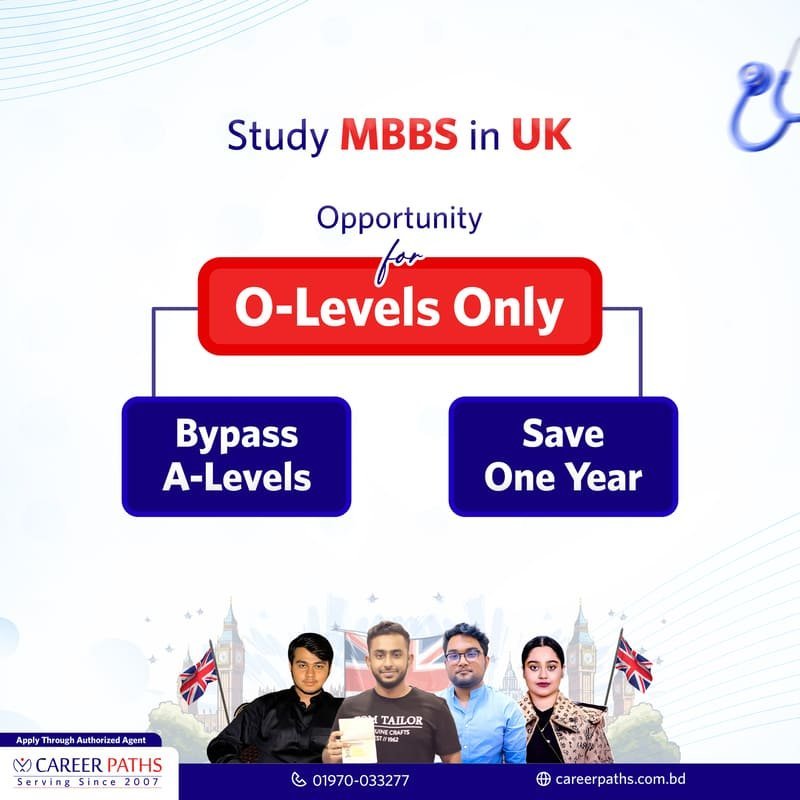
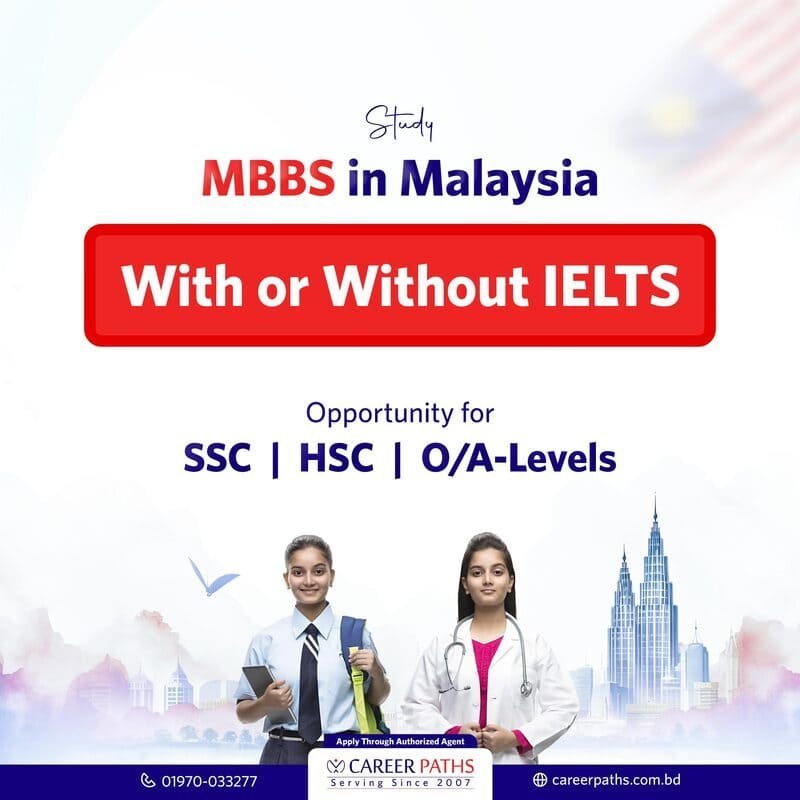
MBBS is one of the most preferred subjects in Bangladesh. Due to very high competition, many students can not get admitted to Local Institutions. Studying MBBS abroad will be a great choice for them due to easy admission process, global recognition, and Worldwide job opportunities. Normally, HSC, A-Level (12 Grade) Student with good academic grades in Science Background can apply for MBBS abroad. Additionally, O-Level, AS-Level and SSC students with good grade have a great opportunity to bypass A-level or HSC and get direct route to MBBS Degree abroad.
Universities from UK, USA, Canada, Australia, Europe has different academic and English Proficiency Requirements for Bangladeshi Students. Let’s see some of the basic academic requirements below to get admission.
General Entry Requirements for MBBS Admission:
- SSC/HSC/O-level/A-Level MBBS with a minimum GPA of 3.50 out of 5.00 or equivalent (Depending on the Universities and programme)
- IELTS Requirement: 5.5 to 6.5 (Depending on the universities & Programme)
General Checklist For Admission & Visa Application
- Transcripts/Academic Records from Secondary School and Post-secondary Education
- Photocopies of All Academic Transcripts and Certificates
- Letter of Acceptance / Offer Letter from the University or College
- The Reference Number for the Confirmation of Acceptance for Studies (CAS) and the Documents Used to get the CAS
- Recommendation Letters (Minimum Two or based on destination country requirement)
- Statement of Purpose (SOP)
- Curriculum Vitae (CV)
- Valid Passport (with at least 6 months to 1 year of validity)
- Photocopy of Passport
- National ID (NID) Photocopy
- Passport-sized Photographs (as per required size and number)
- Birth Certificate
- Family Photo
- Immigration Medical Examination (IME) Report
- Photocopies of Medical Certificates
- Tuberculosis (TB) Test Report
- IELTS/TOEFL/PTE/Duolingo/MOI Certificate
- Study Plan
- Bank Statement Showing Sufficient Funds
- Proof of Tuition Fee Payment
- Solvency Certificate
- Proof of Fund to Support Yourself
- Source Of Fund
- Filled-out Visa Application Form (Complete and Accurate)
- Visa Application Fee Payment Receipt
- Photograph in Required Format for Visa
- I-20 form by the US university or college you have applied for (for U.S. Applicants)
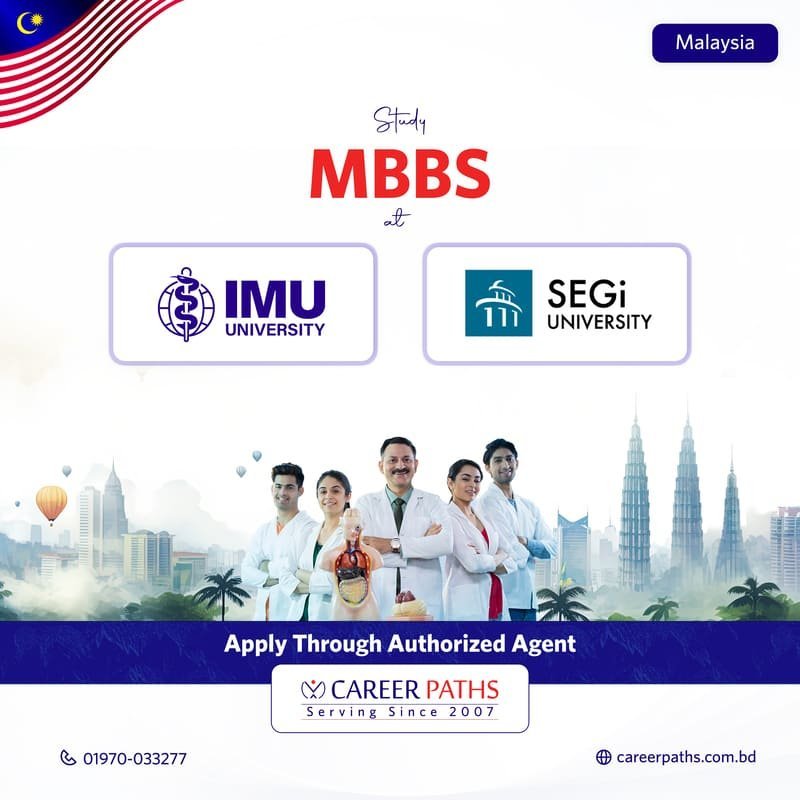
Top Universities To Study MBBS
















Know About the Entrance And License Exam
Know About Entrance Exam of UCAT
The University Clinical Aptitude Test (UCAT) is a standardized admissions exam used by medical and dental schools in the United Kingdom, Australia, and New Zealand to assess the cognitive abilities and professional behaviors of prospective students. Unlike knowledge-based tests, the UCAT evaluates skills essential for a career in healthcare, including critical thinking, problem-solving, decision-making, and situational judgment.
The exam consists of five sections:
- Verbal Reasoning – Assesses comprehension and logical analysis of written information.
- Decision Making – Tests the ability to make sound judgments using complex data.
- Quantitative Reasoning – Measures numerical problem-solving skills.
- Abstract Reasoning – Evaluates pattern recognition and logical thinking.
- Situational Judgment (SJT) – Gauges responses to realistic workplace scenarios, focusing on professionalism and ethical judgment.
The UCAT is computer-based, timed, and highly competitive, with scores playing a crucial role in medical school admissions. Preparation typically involves practice tests, time management strategies, and familiarity with the test format. While the UCAT does not require prior medical knowledge, strong performance is essential for securing interviews at top institutions.
Know About Entrance Exam of MCAT
The Medical College Admission Test (MCAT) is a rigorous, standardized exam designed to evaluate a student’s readiness for medical school in the United States and Canada. Administered by the Association of American Medical Colleges (AAMC), the MCAT is a critical component of the medical school application process, testing not only scientific knowledge but also critical thinking, problem-solving, and analytical reasoning skills. The exam is divided into four sections:
- Biological and Biochemical Foundations of Living Systems – Focuses on biology, organic chemistry, biochemistry, and cellular processes.
- Chemical and Physical Foundations of Biological Systems – Tests general chemistry, physics, and their applications in biological contexts.
- Psychological, Social, and Biological Foundations of Behavior – Covers psychology, sociology, and how behavioral sciences impact health.
- Critical Analysis and Reasoning Skills (CARS) – Assesses reading comprehension and analytical skills through passages on the humanities and social sciences.
The MCAT is a 7.5-hour computer-based test, including breaks, and is scored on a scale ranging from 472 to 528, with the median score for matriculants typically around 511-512. Medical schools weigh MCAT scores heavily, alongside GPA, clinical experience, research, letters of recommendation, and personal statements. Most pre-med students dedicate 3-6 months to intensive preparation, using resources such as the AAMC official materials, Kaplan, Princeton Review, UWorld, and Anki flashcards. Since the exam is offered multiple times per year, strategic timing (usually in the spring or summer before applying) is crucial for optimal performance. A competitive MCAT score significantly enhances an applicant’s chances of securing admission to medical school.
Know About License Exam of USMLE
The United States Medical Licensing Examination (USMLE) is a rigorous, multi-step assessment required for medical licensure in the United States. Designed to evaluate a physician’s competency in applying medical knowledge, clinical skills, and patient care principles, the USMLE is a critical milestone for both U.S. and international medical graduates (IMGs) pursuing residency and practice in the U.S.
The exam is divided into three main steps:
- Step 1: focuses on foundational biomedical sciences, testing knowledge of anatomy, physiology, pharmacology, and pathology in a multiple-choice format. Historically scored as pass/fail (since 2022), it remains a key factor in residency program selection.
- Step 2: consists of two parts: Clinical Knowledge (CK), which assesses diagnostic and clinical management skills, and Clinical Skills (CS), which was discontinued in 2021 and replaced by other competency evaluations like the USMLE Step 2 CS OSCE (if required by specific states or institutions).
- Step 3: is the final assessment, emphasizing patient management, diagnosis, and treatment in both outpatient and inpatient settings. It includes computer-based case simulations (CCS) to evaluate decision-making in real-world scenarios.
The USMLE is jointly administered by the National Board of Medical Examiners (NBME) and the Federation of State Medical Boards (FSMB). Successfully passing all steps is mandatory for obtaining a medical license and securing a residency position through the National Resident Matching Program (NRMP).
Preparation for the USMLE is intensive, often requiring months of dedicated study, question banks (e.g., UWorld), and practice exams. The exam’s difficulty and high stakes make it one of the most challenging medical licensing tests globally. For IMGs, additional requirements like ECFMG certification add another layer of complexity. Ultimately, the USMLE ensures that physicians meet a standardized level of competence before entering the U.S. healthcare system.