
Career Paths

May 3, 2023

IELTS
Blog, Study Abroad from Bangladesh

IELTS: The Essential English Language Test for Studying Abroad

The test assesses the language abilities of candidates and adheres to strict international standards of language assessment. IELTS is recognized by universities, employers, professional organizations, immigration agencies, and government bodies in various countries such as Australia, Canada, New Zealand, the UK, and the USA. There are 4 sections in the IELTS exam: Listening, Reading, Writing and Speaking. We have provided the test format below.   IELTS Academic Questions Listening 30 mins 40 Reading 60 mins 40 Writing 60 mins 2 tasks Speaking 11-14 mins 3 parts The IELTS score ranges from 0 to 9. We have provided a breakdown of scores below. Band Score Skill Level Band 9 Expert user Band 8 Very good user Band 7 Good user Band 6 Competent user Band 5 Modest user Band 4 Limited user Band 3 Extremely limited user Band 2 Intermittent user Band 1 Non-user Band 0 Did not attempt the test Which countries accept IELTS for study? The International English Language Testing System (IELTS) is widely recognized by over 8,000 organizations globally and is the most sought-after English language assessment, with over 2 million exams administered in the previous year. The UK, USA, Australia, New Zealand and Canada are popular study destinations for students taking the IELTS test. Other countries such as: Czech Republic, Denmark, Finland, France, Italy, Malaysia, Netherlands, Portugal, Sweden, Switzerland, Turkey and others accept IELTS for study purposes. What IELTS score is required to study abroad? Each nation has its own specified minimum IELTS scores that have been listed in the table below. Country Bachelor Master’s PhD Australia 6.0 (no band below 5.5) 6.5 (no band below 6) 6.5 Canada 6.5 (no band below 6) 6.5 (no band below 6) 6.5 to 7.0 Denmark 6.0 (no band below 5) 6.5 6.5 Finland 6.5 6.5 7.0 France 6.0 6.5 6.5 Malaysia 6.0 (no band below 5.5) 6.0 to 6.5 6.5 Netherlands 6.5 (no band below 6) 6.5 (no band below 6) 7.0 Sweden 6.0 (no band below 5.5) 6.5 (no band below 6) 6.5 UK Foundation: UKVI IELTS – 4.5Bachelor: UKVI IELTS – 6.0Pre Masters/Masters: UKVI IELTS – 6.5 6.5 (no band below 6) 7.0 USA 6.0 (no band below 5.5) 6.5 (no band below 6) 6.5 Can I study abroad only with IELTS IELTS is a highly recognized English language proficiency test, commonly required for admission into foreign universities for higher education. It serves as evidence of one’s English language abilities and is often a requirement by universities in first-world countries. Each university has their own specific admission criteria and while a good score on an internationally recognized English language test such as IELTS is usually mandatory, it may not be sufficient in all cases. For instance, some MBA programs may also require a score on a different test, such as the GRE or GMAT. A research based program requires research articles, publications, and work experience, besides IELTS and decent academic profile/ background. Although IELTS is not always enough to study abroad, it remains a necessary qualification for many overseas educational institutions. It is advisable to thoroughly review the requirements of both the university and the specific program as listed on their official website. IELTS Exam 2023: Exam dates, Registration, Fees, Eligibility ` Eligibility There are no specified IELTS eligibility requirements established for 2023 by organizations like IDP and British Council. The IELTS exam is a tool for assessing English language proficiency, intended for individuals seeking educational or professional opportunities in English-speaking countries. Although a basic understanding of the English language is recommended, there are no specific GPA requirements. However, it is important to note that the minimum age for taking the IELTS is 16, and a valid passport is necessary. Fees The IELTS test is available at multiple test centers throughout Bangladesh, with a range of test dates to choose from. You can take the test in either paper or computer-based format, but in either case, you will need to visit a test center to complete the test. In Bangladesh, the IELTS paper test is available in Dhaka, Chattogram, Sylhet, Barishal, Khulna, Cumilla, Rajshahi, and Cox’s Bazar. The computer-based test is only available in Dhaka, Chattogram, and Sylhet. IELTS Academic General Training UKVI Paper 20,250 20,250 22,550 Computer 20,250 20,250 22,550 Registration and Exam dates You can book your IELTS exam either online or in person at a nearby test center. To do so, follow these steps- 1) Choose your preferred test location from the available options,2) Decide on the type of test you want to take (Academic or General Training),3) Select a convenient test date,4) Click the “Book Test” button,5) Fill out the required information in the online application,6) Pay the test fee to complete the booking process.To know more about the upcoming exam dates, visit IDP or British Council website. Is 7 a good score in IELTS? A score of 7 in IELTS is considered to be a good score and indicates that the test taker has a high level of English proficiency. It is in the upper range of the IELTS scale, which ranges from 0 to 9. A score of 7 is typically required for many academic programs and for immigration purposes in English-speaking countries. If you achieve a 7 on the IELTS test, you will likely be eligible to enroll in the majority of programs and degrees offered by prestigious universities globally, as long as none of your individual scores in the four components fall below 6 or 6.5. However, it is important to keep in mind that the required score and eligibility can vary depending on the organization or institution.  

PhD Degree
Blog, Study Abroad from Bangladesh

Become a PhD Student : Steps to Follow

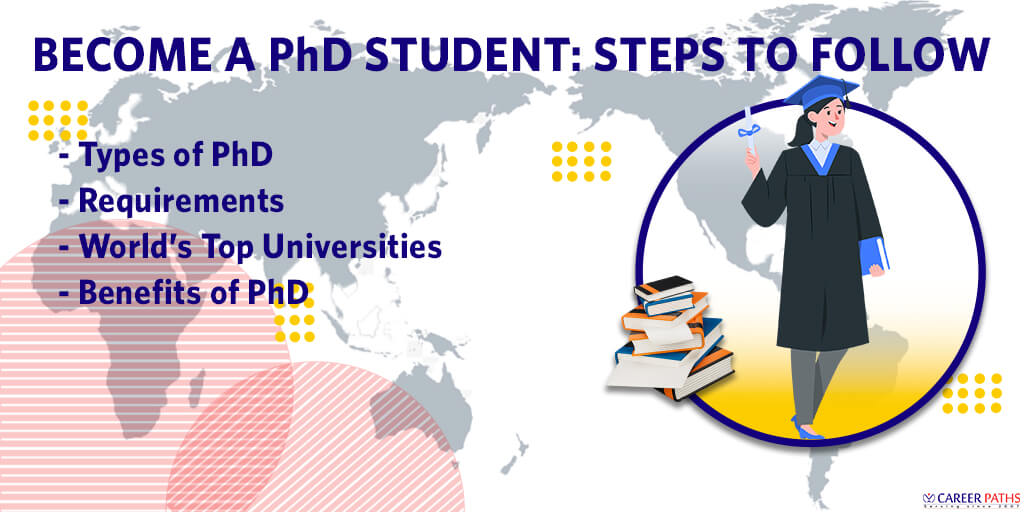
Are you worried about pursuing a PhD degree and looking for a complete step-by-step guide but you don’t know whether it is for you or not? Then this article is only for you. You will get to know what are the good things to become a PhD student. Becoming a PhD student is not as easy as in other programmes. It is regarded as one of the most prestigious degrees as it is the top level of the academic system in the world. Hence, the application process is also lengthier but it is not impossible for you if you go through our in-depth details and step-by-step guidelines. Let us help you to explore the idea of doing a PhD. What is a PhD Degree? A PhD degree is also known as a doctorate degree. It is the highest academic level that a student can achieve. PhD, a Latin term (Ph)ilosophiae and (D)octor, is the shorter version of Doctor of Philosophy which is also written as DPhil. If you earn the PhD degree then you will be entitled to use the title, Doctor. As it is the highest level of education, the path is not as easy as other degrees. A simple way to describe the PhD degree is when you get your associate’s degree, you know a little bit about a subject. When you get your Bachelo’s degree, you are pretty well versed in a subject, and you know a lot about it. When you get the Master’s degree, you are like an expert and you are a master in that subject. Lastly, when you get the PhD degree, you know so much about a certain subject that you can move the entire field forward and discover completely new things as you have a high level of understanding of the subject that instead of reading the books, you can write the books yourself. PhD is discovering something new that resonated with you as an individual. Moreover, it is discovering something new in an area of research and an idea of advancing knowledge. A PhD degree develops every human being academically, in writing skills, analysis skills, communication skills, and many more. You might be surprised to hear that a PhD degree is not just about all the intellectual skills that you are going to develop, there are a lot of other skills that you really learn Types of PhD There are so many factors related to the PhD degree such as coursework, research, exploration, evaluation, and so on. Hence, there are different ways to do PhD degree through which you can achieve this prestigious degree. They are- Thesis-based PhD, Publication-based PhD, Professional Doctorate, Integrated PhD, and Distance PhD. Besides, there are only two types of PhD degrees. They are- Academic Professional Below we are naming some of the top PhD Qualifications that are famous around the world. It is to be noted that we haven’t covered all the qualifications as there are so many available degrees. PhD Qualification Full Title of the PhD degree Subjects Duration Types PhD / DPhil Doctor of Philosophy All Minimum 4 to 7 years. Maximum 8 to 10 years. Academic EdD / D.Ed Doctor of Education Education Minimum 3 years. Maximum 8 years Professional DSocSci Doctor of Social Science Social Sciences Minimum 4 years Professional EngD / PhD (Eng) Doctor of Engineering Engineering 3 – 5 years Professional DBA Doctor of Business Administration Business Minimum 4 years. Maximum 6/7 years Professional DProf Doctor of Professional Studies All 4 – 5 years Professional DArch Doctor of Architecture Architecture Minimum 3 years Professional MD Doctor of Medicine Medicine and Health Sciences Maximum 6 years Professional   Requirements to do PhD As PhD is the highest level and rich academic degree so its requirements are also long and unique. It is not that anyone from any background can do PhD degree. There are many terms and conditions inherent in doing PhD. There are multiple terms and conditions. Moreover, every year the eligibility, rule and teams, and conditions of obtaining a PhD change. According to the PhD application guide 2023, among other requirements, let us explore the basic requirements to apply for a PhD degree. Master’s degree: It is a mandatory prior step to apply for Phd degree. However, in some countries, you can apply for PhD after finishing your bachelor’s. In this case, there will be implied some other terms and conditions. Research proposal: A research proposal isIn most of the PhD programmes in the world, the Research proposal is 1000 – 4000 words, however, the word limit varies from university to university. Not every university requires a research proposal. English proficiency: If you are willing to do PhD in any other language except your mother tongue then you must go through a language test. If it is English then IELTS or TOFEL would help you. In most of the PhD programmes in the world IELTS minimum of 6.5 in an overall band is required however, the score varies from university to university. Statement of Purpose. Curriculum vita. Copy of a valid passport. Copies of academic certificates, transcripts, and reference letters. Age Factor here is no age limit to doing PhD in all over the world. But if you are looking for fellowship then there will age limitation based on streams. You can do it at any age of your life when all the requirements of doing a PhD are met. But it is to be calculated and realized whether doing a PhD at that age is fruitful for you or not. There are various factors like, can you complete the PhD degree at that specific age, or can it bring positivity to your life, and so on. Steps of Becoming a PhD Holder The steps to do a PhD degree are very lengthy and challenging. You have to go through mandatory processes. It is to be noted that PhD’s steps are varied from country to country and university to university. Hence, some of the main processes are emphasized below- Shortlist your
UK Student Approval
Blog, UK

Maximizing Your Chances of UK Student Visa Approval with Adequate Maintenance Funds

The term Maintenance funds refers to the necessary financial resources that must be accessible to you or any dependents traveling with you. It is a requirement to demonstrate that you have sufficient financial means to cover your living expenses and any remaining course fees in the United Kingdom. The amount required depends on the duration of your course and the amount of course fees already paid. It’s important to note that failing to meet the maintenance requirement is a common cause of denial for Student visa applications. The amount of funds required is contingent upon your specific situation and the purpose of your application. You must possess sufficient funds to cover the cost of your course for a maximum of nine months, or one academic year. The exact amount due can be found in your Confirmation of Acceptance for Studies (CAS). If you have already resided in the UK for a period of 12 months or longer with a valid visa, proof of these funds will not be necessary for your visa application. UK Tier 4 Dependent Visa maintenance funds If a student has a student visa, their family members (wife or children) must apply for a Dependent Visa, which has the same length as the student’s visa. This is only applicable for Master’s degree programs and the course must be a minimum of 9 months long and at a level 7 or higher on the RQF scale. Undergraduate students cannot bring their dependents with them to the UK. The dependents of a student with a student visa must apply as “dependents of a Points Based System migrant. ” Each family member must fill out a separate application form and pay a separate fee. To cover the living expenses of the dependents, the student must provide additional funds equal to £845 within London or £680 outside London per dependent per month of the visa application, up to a maximum of 9 months. In the event that the student has already secured a scholarship, the scholarship monies may be utilized to pay for the living costs of the dependents. However, the scholarship documentation must clearly state that the funds are earmarked for the dependents as well. What are the maintenance funds UK Visa? /Proof of funding required for UK visit Visa In order to be eligible for a visa to visit the United Kingdom, the applicant must comply with the vital criteria outlined in Appendix V of the Immigration Rules (HC395, as amended). These requirements include demonstrating to the Home Office that they are a legitimate visitor and that they have the intention of departing from the UK after the conclusion of their visit. When applying for a UK visit visa, the Home Office did not mandate a specific minimum amount of financial funds that must be demonstrated, unlike for spouse and partner visas. However, the Home Office has become increasingly stringent in requiring extensive documentation to support the applicant’s ability to finance their stay in the UK and the source of these funds. Evidence of regular employment income, such as pay slips and bank statements that show the salary being deposited into the applicant’s bank account, can be beneficial. A letter from the employer that confirms the salary amount, payment schedule, and the applicant’s job responsibilities may also be useful. The documentation of employment should show that the applicant has sufficient income to cover the cost of their trip to the UK. For other sources of income, such as dividends, rental proceeds, or pensions, the applicant must provide clear evidence of the funds entering their bank account, as well as documentary evidence of the source, such as share and rental agreements or a letter from the pension provider. It is ideal to show a history of regular payments and that these payments are expected to continue. The Home Office may also take into consideration the documents that show the profits and operations of the business if the applicant is presenting evidence of their business. The applicant should provide evidence of having saved sufficient funds for their trip, whether obtained through work or other means. The applicant must provide bank statements displaying the available funds and the source of the funds. If the funds were given by another person, it can be considered as support from a third party. The financial support for an applicant’s visit to the UK can also come from an external source, such as a family member, friend, organization, or a colleague with whom the applicant has a professional connection. The third-party support must furnish proof of their association with the applicant, for instance, through birth certificates or a letter from the organization or colleague that outlines their relationship and the details of the applicant’s trip. Additionally, it would be beneficial to present evidence of the closeness of their relationship, such as pictures or communication records. The third party must also acknowledge their responsibilities by providing an undertaking, and evidence of their income and ability to support themselves and any dependents, if relevant. The Home Office will consider the third party’s past record of providing support and their immigration status in the UK. What are the maintenance funds UK Student Visa? To study in the UK, you must have sufficient funds to cover the cost of your course and support yourself. The amount required varies based on your circumstances and the type of visa application. You need to have enough money to cover the cost of 1 academic year, up to 9 months, as stated in your Confirmation of Acceptance for Studies (CAS). If you have been in the UK with a valid visa for 12 months or more, you do not need to provide proof of funds. The amount of money required to support yourself (i.e. accommodation, food, other minor expenses) depends on the location of your study. For courses in London, you will need £1,334 per month for 9 months, and for courses outside of London, you will need £1,023 per month for 9 months. If you are

ATAS-Certificate
Blog, UK

Navigating the ATAS Approval Process for International Students

The Academic Technology Approval Scheme (ATAS) is a requirement for non-exempt international students and researchers who are subject to UK immigration control and seeking to pursue postgraduate studies or research in certain sensitive subjects. The sensitive subjects in question involve knowledge that could potentially be used to develop advanced conventional military technology, weapons of mass destruction, or delivery systems for such weapons. To study or engage in research in these areas in the UK, a researcher or student must apply for and obtain an ATAS certificate. Exempt from the ATAS requirement are nationals from EU countries, the European Economic Area, Australia, Canada, Japan, New Zealand, Singapore, South Korea, Switzerland, and the United States. All other nationalities must apply for an ATAS certificate if they plan to study or research in the designated sensitive subjects at the postgraduate level in the UK. Undergraduates who are enrolling in a course with an integrated master’s year may also be required to obtain ATAS clearance. The entry clearance officer (ECO) will request to view your Academic Technology Approval Scheme (ATAS) certificate during the process of applying for entry into the United Kingdom. Additionally, the person handling your case will also require you to produce the ATAS certificate when applying for permission to reside in the UK. According to UK immigration laws, it is illegal for universities and research institutions to permit non-EEA students or researchers to participate in study or research programs in fields related to sensitive technology and engineering without a valid ATAS certificate. How do I get an ATAS Certificate in the UK? The ATAS certificate application process is done online on the GOV.UK website and there is no charge for it. The applicant must have received an offer letter from UCL, which includes all the information needed for the application. The ATAS certificate is specific to both the intended program of study and the university. If the applicant has received offers from multiple universities, they must apply for separate ATAS certificates. For research programs at UCL, early contact with the prospective supervisor is recommended as a brief description of the research proposal must be included in the offer letter. We have provided a brief set of guidelines that can help to ensure a smooth application process for an ATAS certificate. The applicant should provide complete and accurate information, including the full names of their referees and employers, details of two referees they have known for at least 3 years with one being an academic referee, employment history, passport information, research statements, and a personal statement. Additionally, they should ensure there are no gaps in their education or employment history and enter the correct code for their course or research area. It is recommended to carefully review all the information provided before submitting the application as the information will be printed on the certificate. According to the ATAS team, they have a goal of providing a response to all ATAS applications within 20 working days from the date of submission. However, this time frame may be extended during periods of high demand. It is highly recommended to apply for ATAS clearance as soon as possible to avoid any potential delays. What is an ATAS Certificate for? According to UK immigration laws, individuals who are newly accepted to study in the UK and are required to obtain an Academic Technology Approval Scheme (ATAS) certificate, must obtain the certificate prior to applying for permission to enter the country. It is recommended that individuals apply for their ATAS certificate as soon as they receive a conditional offer to study at a UK Higher Education Institution (HEI), which should be at least six months prior to the start of their course. The ATAS certificate is valid for six months from the date of issuance to allow sufficient time for the individual to apply for their UK visa. It is important to ensure that the ATAS certificate does not expire before applying for the visa. ATAS: An Essential Requirement for UK Visa and CAS Applications ATAS certificate is a necessary requirement when applying for a Confirmation of Acceptance for Studies (CAS). If the student has applied to programs or universities that require ATAS according to UK immigration law, the student must obtain an ATAS certificate before proceeding with the CAS application process. It is important to note that ATAS clearance must be obtained before applying for a Visa as well.

Scroll to Top